 TZS
 KES - Kenya
 UGX - Uganda
 RWF - Rwanda
 NGN - Nigeria
 ZAR - South Africa
 USD - Zimbabwe
 GHS - Ghana
 ETB - Ethiopia
 ZMW - Zambia
 USD - International

Introduction
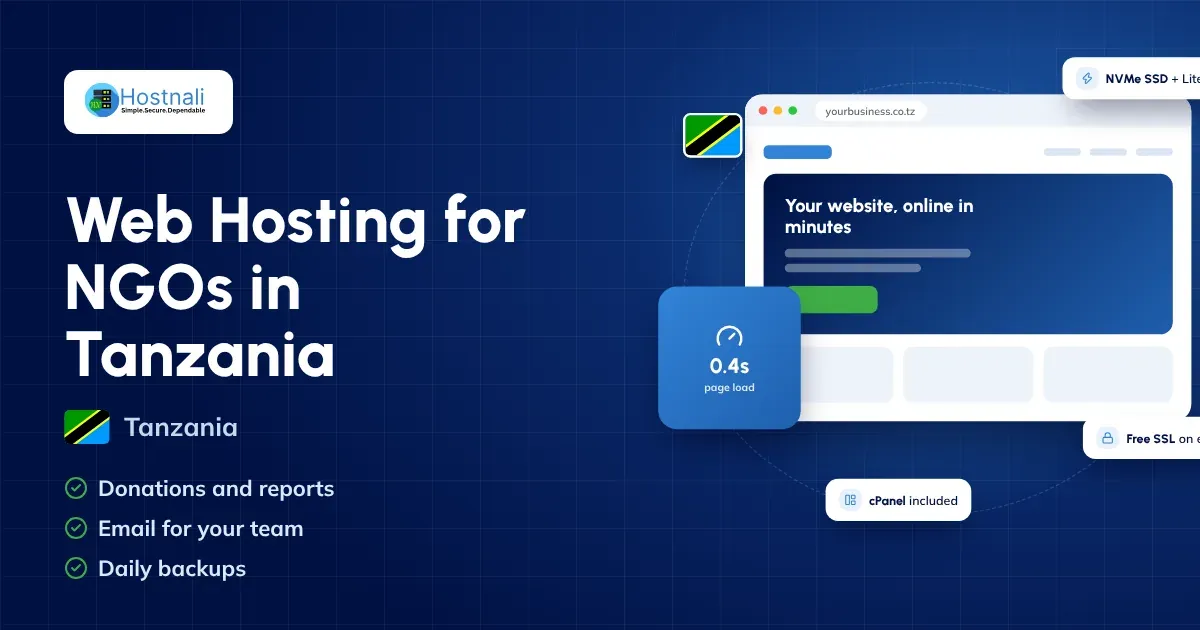
Non-governmental organisations (NGOs), charities and nonprofit organisations do important work across Tanzania. They support education, healthcare, conservation and wildlife protection, youth empowerment, women’s rights, clean water, community development, food security and many other causes, from Dar es Salaam and Dodoma to rural districts around Kigoma, Mtwara and the Lake Zone.
To communicate well with donors, beneficiaries, volunteers, partners and the public, an organisation needs a dependable online presence. A professional website can explain its mission, show its projects, publish reports, announce events, recruit volunteers and tell people how they can help.
Building the website is only part of the job. The organisation also needs suitable web hosting to keep the site online, protect its information and support future growth.
Choosing the best web hosting for NGOs in Tanzania does not mean buying the most expensive package. A small community-based organisation may need only a simple website, professional email and a few downloadable documents. A national charity that takes online donations, publishes regular reports and serves thousands of visitors may need more resources and stronger technical support.
This guide explains how Tanzanian NGOs and nonprofits can choose hosting that fits their mission, operating budget and technical needs in 2026.
What Is Web Hosting for NGOs and Nonprofits?
Web hosting is a service that stores a website’s files and makes them available to visitors over the internet. Those files include web pages, photos, documents, databases and application components.
NGO hosting simply means web hosting chosen for the needs of charities, community-based organisations, foundations, advocacy groups and other nonprofit institutions.
Depending on the package and website setup, it can support:
- The organisation’s official website.
- Project and programme pages.
- Annual reports and downloadable publications.
- Volunteer registration and partnership enquiry forms.
- Donation information and online giving integrations.
- News, events and impact stories.
- Professional email addresses on the organisation’s domain.
- Several project websites or regional pages.
- Secure portals and other specialised applications where the hosting supports them.
Hosting is the technical foundation of the website. It does not automatically include website design, fundraising software, payment processing, legal compliance or ongoing content management. Those may need extra tools or services.
Why NGOs in Tanzania Need a Professional Website
1. Build credibility with donors and partners
Donors and grant-makers usually want to understand an NGO’s mission, leadership, programmes, registration details and results before they decide to support it.
A well-organised website gives the organisation one central place to publish approved information, explain its work and share important documents.
Where appropriate, include:
- The organisation’s mission and objectives.
- Registration or legal identity information.
- Board and leadership details approved for publication.
- Current programmes and the communities served.
- Annual reports and audited financial statements where available.
- Contact details and partnership information.
- Safeguarding, privacy and other relevant policies.
Hosting cannot guarantee donor confidence or funding. Reliable access to accurate, up-to-date information does help the organisation present itself professionally.
2. Reach beneficiaries and communities
An NGO may work in several regions, from the coast to the southern highlands. A website can explain services, programme locations, eligibility, how to apply and upcoming activities. Publishing key pages in both Kiswahili and English can make them far more useful to the communities you serve.
Most visitors browse on mobile phones, often on limited data, so the website should be mobile-friendly and avoid unnecessarily large images or downloads.
3. Make fundraising information easy to find
A website can explain how people can support a cause, whether through bank transfer, mobile money, a fundraising campaign or an integrated online donation system.
If the organisation takes online payments, the hosting and website setup must support the chosen payment integration. Payment processing, security controls and donor-data handling need to be considered separately from the hosting package.
4. Support volunteers and partnerships
Volunteer forms, internship notices and partnership enquiries help organisations connect with people who want to give their time, skills or resources.
Test these forms regularly so that submissions reach the right team and are handled securely.
5. Keep an accessible record of impact
Organisations can publish project updates, photos used with proper permission, evaluation reports and summaries of completed activities.
A reliable website with good backups protects these resources from accidental deletion or technical failure.
Which Type of Hosting Is Best for an NGO?
The right hosting type depends on the organisation’s website, budget, traffic and technical needs.
| Hosting type | Suitable for | Important consideration |
|---|---|---|
| Shared hosting | Small NGOs and community organisations with standard websites | Affordable, but server resources are shared |
| WordPress hosting | NGOs using WordPress to publish programmes, news and reports | Check compatibility, resources and backup arrangements |
| Managed WordPress hosting | Organisations that want extra WordPress maintenance support | Confirm exactly which management services are included |
| VPS hosting | Growing NGOs with demanding websites or specialised applications | More control and resources may need technical administration |
| Cloud hosting | Organisations needing a scalable environment for suitable applications | Architecture, pricing and management vary by provider |
| Dedicated server | Large organisations with heavy workloads or specific infrastructure needs | Usually costs more and needs more administration |
Shared hosting for small NGOs
Shared hosting is a practical starting point for a small charity or community-based organisation that needs a standard information website.
Depending on the package, it can handle programme pages, reports, contact forms, news and professional email.
Before you buy, review the storage allowance, database support, email limits, backup policy, security features and resource limits. A low price only helps if the package meets the organisation’s real needs. Hostnali’s affordable web hosting includes free SSL, unlimited email accounts and daily backups on every plan.
WordPress hosting for nonprofits
WordPress is a popular choice for organisations that want to publish and update content without building every page from scratch.
With compatible plugins and integrations it handles programme pages, news, downloadable reports, volunteer forms and donations.
The hosting should support the required WordPress and PHP versions, database, HTTPS and plugins. Keep WordPress, themes and plugins updated to reduce security and compatibility risks. See WordPress hosting for plans with staging and automatic updates.
VPS hosting for larger organisations
A virtual private server (VPS) may suit an NGO with higher traffic, several applications, specialised integrations or a need for more control.
For example, an organisation running a resource-heavy portal or a custom monitoring and evaluation application may need more predictable resources than a basic shared package offers.
A VPS is not automatically the best choice for every nonprofit. It needs server administration, monitoring, security configuration and maintenance, and Hostnali VPS plans are self-managed unless you add the managed option. If the organisation lacks technical staff, consider managed VPS.
10 Important Features to Look for in NGO Hosting
1. Reliable uptime
Uptime is how long a website stays reachable. If the site goes down during a fundraising campaign or a key programme announcement, people may struggle to find information or take action.
Review the provider’s uptime commitment, service-level terms, exclusions and outage reporting. Read any published uptime figure alongside the actual terms of service. Hostnali offers a 99.99% uptime guarantee, explained in our article on what 99.99% uptime really means.
No hosting provider can guarantee a website will never be interrupted.
2. Enough storage and resources
NGO websites often hold reports, photos, event galleries, publications and videos. Unoptimised, these files use a lot of storage.
Check storage, CPU, memory, database limits and any traffic policies. If you expect a big spike in visitors during a campaign, discuss the extra resources you may need.
Compress images and keep documents to a sensible size so pages load quickly.
3. SSL certificates and HTTPS
HTTPS encrypts information between a visitor’s browser and the website. An SSL/TLS certificate enables this secure connection.
Choose a package that supports HTTPS and lets the certificate install and renew properly. This matters most for sites with login pages, contact forms or donation integrations.
An SSL certificate alone does not make a site completely secure. Software updates, access controls, secure payment integrations and good data handling are also needed.
4. Regular backups
Backups let an organisation recover its website after accidental deletion, a failed update, a security incident or another technical problem.
Ask the provider:
- How often are backups created?
- How long are they kept?
- Are they stored separately from the live website?
- Can the organisation ask for a restore?
- Is restoring included in the package?
- Can the NGO download or keep its own backup?
Keep an independent copy of important files and databases where practical. Test restoring rather than assuming a backup will always work.
5. Professional email
An organisation can use its own domain for addresses such as [email protected], [email protected] or [email protected].
Professional email supports consistent communication with donors, government offices, development partners and beneficiaries.
Check whether email is included with hosting or sold separately, and review mailbox storage, sending limits, spam protection and account recovery. Our guide to setting up professional email with your domain covers the steps.
Configure email authentication records such as SPF, DKIM and DMARC where supported to help protect the organisation’s domain from spoofing.
6. Security and access controls
Only authorised people should administer the website. Shared passwords, unused accounts and outdated plugins all raise the risk.
Use strong unique passwords, two-factor authentication where available, timely updates, sensible permissions and monitoring for suspicious activity.
Assign clear responsibility for maintaining the site, managing user accounts and responding to security alerts.
7. Support and technical help
Some NGOs have their own IT staff; others rely on volunteers or a part-time website administrator.
Check how to contact support, when it is available and what help is included. Ask whether support covers server problems only or also helps with WordPress, email setup and website migration. Hostnali support is available 24/7 by live chat and ticket.
8. Scalability
A website grows as new projects launch, reports are published and campaigns attract more visitors.
Choose a provider with a clear upgrade path. Ask how storage and resource upgrades work, whether a migration is needed and what extra costs apply.
9. Domain ownership and clear renewals
The organisation should keep control of its domain name and registration account. This matters when staff change, a volunteer leaves or the website moves to another provider.
Check registration and renewal prices, the account recovery process and who has administrative access.
10. Website migration
An NGO with an existing website may need to move it to a new provider.
Before moving, confirm whether the new provider helps and whether the move covers files, databases, email and DNS. Plan the move to limit disruption and check the website, forms and email afterwards. Hostnali migrates websites free of charge.
How Much Does NGO Web Hosting Cost in Tanzania?
Hosting costs depend on the website’s size, resources, management needs and included features.
A small organisation can start on a basic shared plan, which at Hostnali starts from TZS 47,960 a year. A nonprofit with a donation platform, high traffic or specialised applications needs a bigger budget.
Rather than looking only at the advertised starting price, prepare a budget that covers these items.
| Expense | What to check |
|---|---|
| Domain name | Registration, renewal and ownership |
| Web hosting | Resources, storage, support and security |
| Website design | Initial development, branding and content |
| Professional email | Mailbox count, storage and authentication |
| Website maintenance | Updates, monitoring and troubleshooting |
| Backups | Frequency, retention, restoration and independent copies |
| Donation integration | Payment gateway compatibility and transaction fees |
| Additional applications | Volunteer portals, project systems or custom tools |
| Website migration | Transfer of files, databases, email and DNS settings |
Ask for a written quotation that separates one-off costs from recurring ones. Promotional prices may differ from renewal prices, and some features cost extra.
For current package details, visit the Hostnali web hosting plans page and confirm the specifications and prices before you buy.
How to Build an NGO Website in Tanzania
Step 1: Define what the website must achieve
Decide what the site needs to do. A small community organisation may need a mission statement, programme details and contact information. A larger charity may need many programme pages, reports, donations and volunteer forms.
Start with the essentials and add features as the organisation’s needs develop.
Step 2: Choose a domain name
Pick a domain that reflects the organisation’s official name and is easy to say and share.
A .org domain suits a nonprofit with an international audience, while .or.tz is the Tanzanian extension intended for organisations. Other extensions, including .co.tz, may also work. If the registry asks for registration details or documents, our team tells you what to send.
Check availability and renewal costs on the domain registration page. Register the domain in the organisation’s name and control, not only a single staff member’s or contractor’s.
Step 3: Choose suitable web hosting
Compare providers on reliability, storage, security, backups, support and upgrade options.
Choose a package that supports your website platform and any donation or volunteer integrations. Do not buy an advanced server unless the organisation genuinely needs the extra resources or control.
Step 4: Create the essential pages
A typical NGO website includes:
- Home.
- About the organisation.
- Mission and objectives.
- Programmes and projects.
- Impact stories and results.
- Reports and publications.
- Get involved or volunteer.
- Donate or support our work.
- News and events.
- Contact.
- Privacy notice and relevant policies.
Only publish information approved for public release. Review reports, photos and beneficiary stories for privacy and consent.
Step 5: Set up official email
Create role-based addresses where useful, such as info@, programmes@ and partnerships@.
Give access only to authorised staff and write down how accounts are handed over when a staff member or volunteer leaves.
Step 6: Set up donation and enquiry forms
If the NGO takes donations online, choose a reputable payment provider and check its supported payment methods, fees, settlement terms and integration requirements.
Many Tanzanian supporters prefer mobile money wallets such as M-Pesa and Airtel Money. If you want to accept them, confirm that the chosen gateway supports the payment flow you need and that payment confirmations are handled correctly. Do not assume a hosting package includes payment processing.
Test donation and enquiry forms, including email notifications and mobile use, before launch.
Step 7: Secure the website
Turn on HTTPS, use strong passwords, restrict admin access and keep software updated.
Set up backups and decide who responds to security alerts. If the site handles personal information, review what is collected and how it is stored, accessed and deleted.
Step 8: Test and launch
Test the site on mobile phones and computers. Check links, downloadable reports, contact forms, email notifications and donation workflows.
Confirm that the domain points to the right website and that HTTPS works on every page.
Step 9: Keep information current
Assign someone to update programme details, reports, contacts and announcements.
Review the site regularly to remove outdated information, check forms, confirm backups and renew the domain and hosting on time.
NGO Website Security and Data Protection in Tanzania
NGOs collect personal information from beneficiaries, donors, volunteers, staff, applicants and partners. Depending on the work, this may include contact details, photos, application information or sensitive details about people receiving assistance.
Tanzania’s Personal Data Protection Act, 2022 sets out obligations for organisations that collect and process personal data. It is overseen by the Personal Data Protection Commission (PDPC), and organisations that collect or process personal data are required to register with the Commission.
An NGO should assess its own obligations rather than assuming that nonprofit status exempts it. Check how the Act applies to the organisation’s actual activities and to current regulations, and seek qualified advice where needed. Other laws, such as the Electronic Transactions Act, 2015 and the Cybercrimes Act, 2015, may also be relevant to online activity.
Good website practice includes:
- Collect only the information needed for a clear purpose.
- Explain how information submitted through forms will be used.
- Restrict access to authorised people.
- Use HTTPS and keep website software maintained.
- Do not publish beneficiary information without proper authority and safeguards.
- Protect backups and restrict access to them.
- Review the security of third-party forms and donation tools.
- Have a process for handling suspected data breaches.
- Get qualified advice where the organisation’s data processing raises legal questions.
Hosting is only one part of data protection. The organisation remains responsible for how it collects, uses, shares and keeps personal information.
For official information, consult the Personal Data Protection Commission.
Common Hosting Mistakes NGOs Should Avoid
Choosing hosting on price alone: A very low price may not give the resources, support or backups the organisation needs.
Forgetting renewal costs: Budget for the ongoing cost of hosting and the domain, not just the introductory price.
Letting one person control everything: Keep domain ownership and account recovery details under the organisation’s control.
Publishing outdated reports: Old programme or leadership information confuses people. Set up a process for reviewing public content.
Neglecting backups: Keep copies of important files and databases and test restoring from time to time.
Giving too many people admin access: Give each role the minimum permissions it needs and remove access when it is no longer required.
Ignoring mobile performance: Most visitors use phones. Optimise images, cut unnecessary scripts and test pages on small screens.
Assuming hosting guarantees compliance: Technical safeguards help, but the organisation must also follow sound privacy and data-handling practices.
Why Consider Hostnali for Your NGO Website?
Hostnali serves NGOs, charities and community organisations across Tanzania. Shared plans include NVMe SSD storage, LiteSpeed, cPanel, free SSL, unlimited email accounts, Softaculous one-click installs, WordPress staging and automatic updates, daily backups, a 99.99% uptime guarantee, a 30-day money-back guarantee on hosting and free migration.
Compare the current packages against your organisation’s needs. Review storage, resource limits, HTTPS support, email options, backups, support and upgrades.
For a WordPress site, confirm compatibility with the WordPress version, theme and plugins you plan to use. If the organisation needs a high-traffic donation platform or a specialised portal, ask for a technical assessment before choosing the hosting environment. You can reach our team through the contact page.
Visit the Hostnali website to learn more and review the current web hosting packages before you decide.
The right hosting fits the organisation’s budget, protects its website and supports its communication with donors, partners, volunteers and the communities it serves.
Frequently Asked Questions About NGO Hosting in Tanzania
1. Which web hosting is best for NGOs in Tanzania?
It depends on the website, traffic, budget and technical needs. Small NGOs can use suitable shared hosting, while organisations with demanding applications may need managed WordPress, a VPS or another specialised environment.
2. Can a small NGO use shared hosting?
Yes. Shared hosting suits a small information website with programme pages, reports, contact forms and modest traffic. Check resource limits, security features, backups and upgrade options.
3. Can an NGO accept mobile money donations on its website?
Yes, if it uses a payment gateway or integration that supports mobile money and sets it up correctly. Confirm transaction fees, settlement terms, supported payment methods and payment notifications with the provider.
4. Does an NGO website need an SSL certificate?
Yes, it should run on HTTPS. An SSL/TLS certificate enables an encrypted connection between the visitor’s browser and the website. Other security measures are still needed.
5. Can an NGO use WordPress?
Yes. WordPress helps an organisation publish programme pages, news, reports and volunteer information. Donations may need extra plugins or a payment gateway integration.
6. How much does NGO website hosting cost in Tanzania?
It depends on the domain, hosting package, storage, email, maintenance and other features. Hostnali’s shared hosting starts from TZS 47,960 a year. Compare the full renewal price and any extra charges rather than only the advertised starting price.
7. Should an NGO have professional email?
Yes. Email on the organisation’s domain supports consistent communication and makes role-based accounts easy to manage. Check mailbox limits, security features and whether email comes with the hosting package.
8. How can an NGO protect beneficiary information?
Collect only what you need, explain how it will be used, restrict access, keep software secure and review third-party services. Assess the organisation’s obligations under the Personal Data Protection Act, 2022, including registration with the PDPC, and seek qualified advice where necessary.
9. Can an NGO move its website to another hosting provider?
Usually, yes. Plan the move of website files, databases, domain settings and email. Test the site and forms afterwards and keep a backup of the original site until the move is confirmed. See how to move your website to Hostnali.
Final Thoughts
Choosing the best web hosting for NGOs and nonprofits in Tanzania starts with understanding the organisation’s needs. A small community-based organisation may need affordable hosting for a basic website, while a national charity may need more resources, more advanced donation integrations or specialised applications.
Compare hosting on reliability, storage, security, backups, email, support, renewal prices and upgrade options. Protect domain ownership, keep programme information current and manage the website responsibly.
A well-maintained website helps an organisation share its mission and work and makes it easier for donors, partners, volunteers and communities to connect with its programmes.
Ready to build or improve your NGO website? Explore Hostnali’s web hosting plans and choose a package based on your organisation’s real needs.