 TZS
 KES - Kenya
 UGX - Uganda
 RWF - Rwanda
 NGN - Nigeria
 ZAR - South Africa
 USD - Zimbabwe
 GHS - Ghana
 ETB - Ethiopia
 ZMW - Zambia
 USD - International

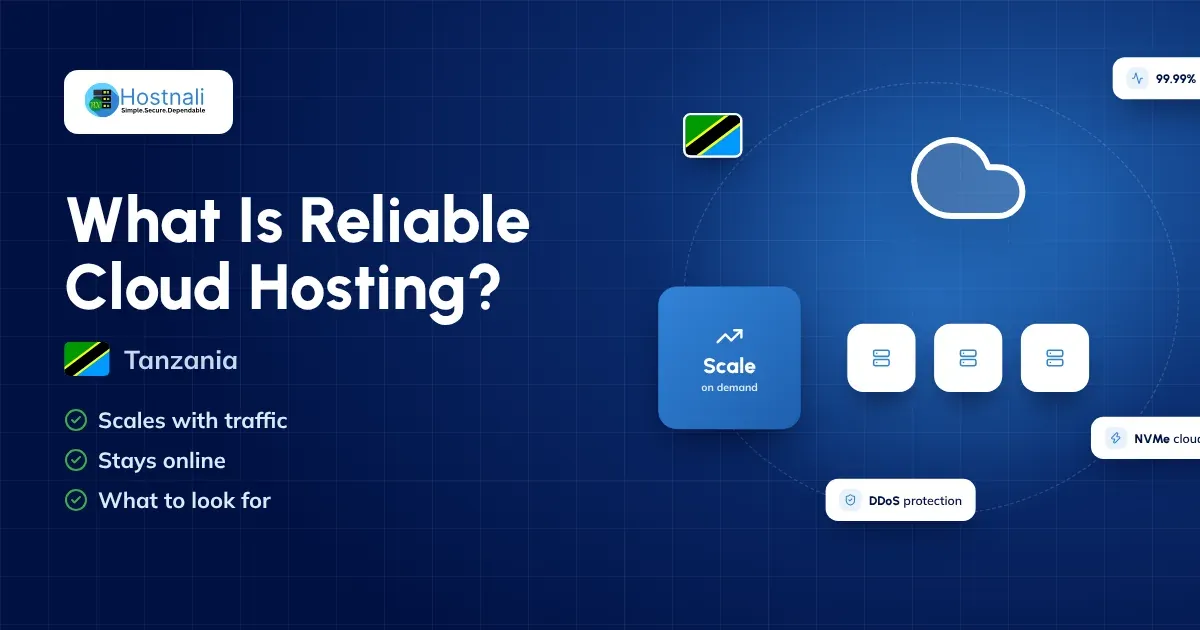
Cloud hosting is a type of web hosting where websites and applications draw on resources from a network of connected servers, rather than relying entirely on one physical machine.
With traditional hosting, your website may depend mainly on a single server.
With cloud hosting, resources can be spread across several servers in a cloud infrastructure.
That brings more flexibility and makes it easier to scale.
Think of it like this:
Two Ways to Host a Website
Traditional Hosting
Your website depends mainly on one server.
Cloud Hosting
Your website uses a network of connected servers and computing resources.
This set-up helps businesses cope with changing resource needs more efficiently.
How Does Cloud Hosting Work?
Cloud hosting links several servers together.
Instead of putting all of a website’s resources on one physical machine, the infrastructure spreads computing resources across a larger network.
Depending on how the cloud platform is built, this gives you access to:
- Processing power
- Memory
- Storage
- Networking resources
- Backup infrastructure
If your website needs more resources, cloud infrastructure can usually be scaled more easily than traditional fixed-server hosting.
A Simple Cloud Hosting Example
Imagine a Tanzanian business running an online shop.
On a normal day, the website gets:
500 visitors a day.
During a big promotion or festive season sale, traffic suddenly jumps to:
10,000 visitors a day.
A traditional hosting set-up with fixed resources may struggle if it does not have enough spare capacity.
Cloud hosting offers a more flexible model where resources can be adjusted to demand, depending on the provider and the plan.
This is one reason cloud hosting appeals to growing businesses.
Cloud Hosting vs Traditional Hosting
The main difference is how resources are provided.
| Feature | Traditional Hosting | Cloud Hosting |
|---|---|---|
| Infrastructure | Often based on one server | Network of connected servers |
| Scalability | May need a plan or server upgrade | Usually more flexible |
| Resource allocation | Usually fixed by the hosting plan | Can be more dynamic |
| Reliability | Depends heavily on one machine | Can use distributed infrastructure |
| Traffic handling | Limited by available server resources | Can scale, depending on the design |
| Cost structure | Usually fixed pricing | Varies by provider |
The exact features depend on the hosting provider.
Why Tanzanian SMEs Are Moving to Cloud Hosting
Businesses in Tanzania depend more and more on their websites and online applications.
A website may be responsible for:
- Generating leads
- Taking online orders
- Handling customer enquiries
- Running business applications
- Managing customer accounts
- Delivering digital services
As a business grows, its hosting needs change too.
Cloud hosting gives flexibility to businesses that need infrastructure able to keep up with growth.
Benefits of Cloud Hosting for Tanzanian Businesses
1. Scalability
Scalability is one of the biggest advantages of cloud hosting.
A growing business will eventually need more:
- CPU
- RAM
- Storage
- Bandwidth
- Database capacity
Cloud infrastructure makes it easier to add resources when you need them.
That is useful for any business that expects to grow.
2. Improved Reliability
Traditional hosting can depend heavily on one server.
If that server suffers a serious hardware failure, the websites on it may go down.
Cloud infrastructure reduces dependence on one physical machine by using distributed resources.
However, real reliability depends on how the cloud platform is designed.
Not every cloud hosting service has the same level of redundancy.
Always ask your hosting provider about:
- Infrastructure redundancy
- Backup systems
- Uptime guarantees
- Disaster recovery
- How data is stored
3. Flexible Resources
With traditional hosting, you may have to move to a whole new plan when your website outgrows its resources.
Cloud hosting can be more flexible, depending on the provider.
Resources can be adjusted as your website grows.
This suits:
- Growing online shops
- SaaS platforms
- Business applications
- Busy websites
- Startups
- Seasonal businesses such as tour operators
4. Better Traffic Handling
A sudden rise in traffic can cause problems for websites with limited server resources.
Cloud hosting is designed to handle changing demand more smoothly.
A business may see more traffic because of:
- Social media campaigns
- Instagram or TikTok promotions
- Product launches
- Festive season sales
- Media coverage
- Marketing campaigns
Being able to scale resources helps businesses get ready for growth.
5. Business Continuity
Businesses rely more and more on digital services.
Website downtime can affect:
- Sales
- Customer communication
- Online bookings
- Applications
- Staff productivity
Cloud infrastructure supports business continuity through distributed resources, backups and redundancy, depending on how it is built.
Cloud Hosting vs Shared Hosting
Shared hosting is usually the most affordable option for new websites.
With shared hosting, many websites use resources on the same physical server.
It suits:
- Blogs
- Portfolio websites
- Small business websites
- New websites
- Websites with low to medium traffic
Cloud hosting may suit you better when a website needs:
- More scalability
- More resources on hand
- More flexibility
- Infrastructure built for growth
Shared Hosting
Best for smaller websites and beginners.
Cloud Hosting
Best for businesses that need more flexibility and scalability.
Cloud Hosting vs VPS Hosting
Cloud hosting and VPS hosting are often confused.
A VPS, or virtual private server, is a virtual server created on a physical server or virtualisation platform.
A VPS usually comes with its own allocated resources.
Cloud hosting uses distributed cloud infrastructure.
VPS Hosting Advantages
- More control
- Dedicated resources
- Full root access
- Flexible server set-up
- The option of a Tanzanian VPS with a Tanzanian IP
Cloud Hosting Advantages
- Scalable infrastructure
- Distributed resources
- Flexible capacity
- Redundancy, depending on the platform
The best option depends on your technical needs.
Cloud Hosting vs Dedicated Servers
A dedicated server gives one customer a whole server.
This provides:
- High performance
- Full control
- Resources that are not shared
- Extensive customisation
Dedicated servers are often used by:
- Large businesses
- Busy applications
- Enterprise systems
- Large online shops
Cloud hosting can be more flexible than a single dedicated server, especially when a business needs infrastructure that scales.
Is Cloud Hosting More Expensive?
Cloud hosting can cost more than basic shared hosting.
But the value depends on what your business needs.
A basic website probably does not need expensive cloud infrastructure.
For example, a small portfolio website with 100 visitors a month will run perfectly well on shared hosting.
A growing online shop or web application, on the other hand, may benefit from more scalable infrastructure.
The right question is not:
“Is cloud hosting cheap?”
Instead, ask:
“Does my business need what cloud hosting offers?”
Who Should Use Cloud Hosting?
Cloud hosting may suit:
Online Shops
Online shops see traffic go up and down.
Cloud infrastructure gives more flexibility to shops that grow or get sudden spikes.
Growing SMEs
Businesses expecting more website traffic can benefit from scalable infrastructure.
Startups
Technology startups can grow quickly.
Cloud infrastructure makes it easier to adjust computing resources as needs change.
SaaS Platforms
Software-as-a-service applications need reliable and scalable servers.
Busy Websites
Websites with large numbers of visitors may need more power than basic shared hosting provides.
Web Applications
Applications with databases, customer accounts and interactive features benefit from scalable infrastructure.
Who Does Not Need Cloud Hosting?
Not every website needs cloud hosting.
You may not need it if you run:
- A simple portfolio
- A small blog
- A basic business website
- A new website with little traffic
In these cases, shared hosting is usually better value.
You can upgrade later when your needs grow.
Cloud Hosting and Website Speed
Cloud hosting does not automatically make a website faster.
Website speed depends on many things, including:
- Server CPU
- RAM
- Storage
- Network performance
- Website optimisation
- Caching
- Images
- Plugins
- Database performance
- Content delivery networks
A poorly optimised website can still be slow on powerful cloud infrastructure.
Equally, a well-optimised website can perform well on standard hosting.
Cloud hosting gives you infrastructure flexibility; it does not replace website optimisation.
Cloud Hosting and Website Security
Cloud hosting providers may offer security features such as:
- Firewalls
- Monitoring
- DDoS protection
- Backups
- Access controls
- Network security
But security responsibilities differ from service to service.
Your business should also:
- Use strong passwords
- Turn on two-factor authentication
- Keep applications updated
- Secure administrator accounts
- Keep backups
- Limit unnecessary access
- Monitor website activity
If your website collects customers’ personal data, remember your duties under Tanzania’s Personal Data Protection Act, 2022, which is overseen by the Personal Data Protection Commission (PDPC).
Cloud hosting does not make an insecure website secure.
Cloud Hosting for Online Shops in Tanzania
Cloud hosting is useful for online shops because they need:
- Reliable availability
- Database performance
- Secure connections
- Scalable resources
- Backup systems
- Good traffic handling
An online shop may see big traffic increases during:
- Black Friday
- Christmas and Eid promotions
- Flash sales
- Influencer campaigns
- Product launches
Choose your hosting based on expected traffic and business needs.
Cloud Hosting for Tanzanian Startups
Startups face a lot of uncertainty.
A startup may have:
100 users today.
Six months later, it could have:
10,000 users.
Cloud infrastructure supports businesses that need flexibility as their technology needs change.
However, startups should avoid paying for resources long before they need them.
Start with a suitable plan and scale as the business grows.
What Should You Look for in a Cloud Hosting Provider?
When comparing providers, look beyond the word “cloud”.
Ask the important questions.
Infrastructure
What kind of infrastructure runs the service?
Scalability
Can resources be increased easily?
Backups
Are automatic backups included?
Security
What security measures are in place?
Uptime
What uptime does the provider guarantee?
Support
Is technical support available when problems happen?
Pricing
Is pricing predictable?
Are there extra usage charges?
Data Locations
Where is the infrastructure? This can affect performance and compliance.
Cloud Hosting Checklist for Tanzanian SMEs
Before choosing cloud hosting, ask:
☐ Does my business really need cloud infrastructure?
☐ Can I scale resources easily?
☐ Are backups included?
☐ Is SSL included?
☐ What security features are available?
☐ What uptime is guaranteed?
☐ Is technical support available?
☐ How is pricing worked out?
☐ Can I upgrade or downgrade resources?
☐ What happens if traffic suddenly rises?
☐ Is migration help available?
This checklist helps you choose a cloud hosting plan based on your real needs.
Why Consider Hostnali for Cloud Hosting?
Hostnali serves businesses, organisations, developers and website owners across Tanzania with cloud hosting and scalable hosting options.
When you assess cloud hosting, look at the whole environment, including:
- Server performance
- NVMe storage
- Security
- Daily backups
- 24/7 support by live chat and ticket
- Scalability
- Resource allocation
- A 99.99% uptime guarantee
The best hosting matches your current needs while giving your business room to grow.
Frequently Asked Questions
What is cloud hosting?
Cloud hosting is a hosting model that uses connected servers and distributed computing resources rather than relying entirely on one physical server.
Is cloud hosting better than shared hosting?
Not necessarily. Cloud hosting gives more flexibility and scalability, but shared hosting is more affordable and is enough for smaller websites.
Is cloud hosting good for online shops?
Yes. Cloud hosting suits online shops that need scalable infrastructure, reliable availability and flexible resources.
Is cloud hosting expensive in Tanzania?
The cost depends on the provider, the infrastructure and the resources you need. It can cost more than basic shared hosting but gives extra flexibility and scalability.
Is cloud hosting faster?
Not automatically. Website speed depends on server resources, infrastructure, caching and website optimisation.
Can a small business use cloud hosting?
Yes. But a small business should first decide whether its website really needs cloud hosting. Our quick answer what is cloud hosting? can help.
Final Thoughts
Cloud hosting is a flexible approach to web infrastructure that uses connected, distributed server resources.
For Tanzanian SMEs, cloud hosting is especially useful when a business needs:
Scalability + flexibility + reliable infrastructure + room to grow.
But cloud hosting is not automatically the best choice for every website.
A small website may run perfectly well on shared hosting.
What matters is choosing hosting for your real needs, not because a technology sounds more advanced.
As your business grows, your hosting can grow with it.
Choose infrastructure with the right balance of performance, reliability, scalability and cost.
Explore Hostnali cloud hosting to find the right option for your Tanzanian business.