 TZS
 KES - Kenya
 UGX - Uganda
 RWF - Rwanda
 NGN - Nigeria
 ZAR - South Africa
 USD - Zimbabwe
 GHS - Ghana
 ETB - Ethiopia
 ZMW - Zambia
 USD - International

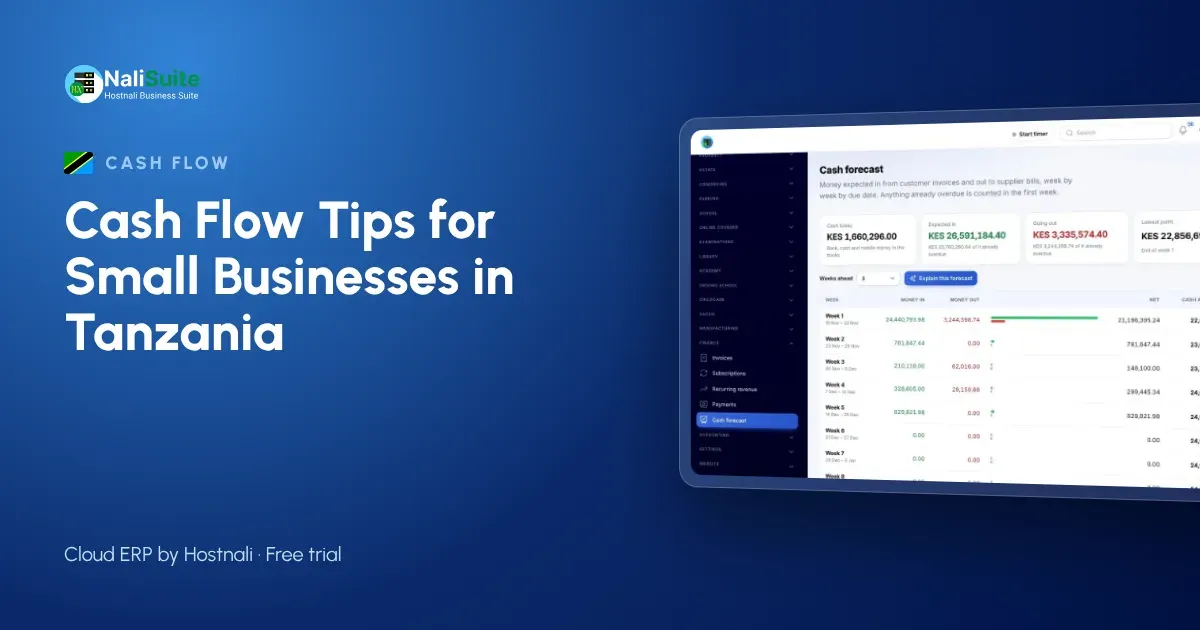
Tanzania’s small businesses often have seasonal income: tourism peaks around Arusha and Zanzibar, harvest cycles in the southern highlands, school terms everywhere. Cash flow management is largely about getting through the quiet months without borrowing at the worst moment.
Map your seasons
Look at the last twelve months of M-Pesa and bank statements and mark the strong and weak months. Most businesses see a pattern. Once you know it, you can build reserves during the busy months to cover the slow ones.
Collect deposits in the busy season
Tour operators, caterers and event businesses can ask for deposits when booking. Record each deposit against the invoice, so you can see the balance still due before the service.
Speed up collection
- Invoice on the day of delivery or service.
- Include the due date and your TIN.
- Let customers pay from the invoice with an M-Pesa or Airtel Money prompt.
- Send a reminder when payment is due.
Control spending in the quiet months
Delay non-essential purchases until income picks up, and negotiate supplier terms that fit your seasons. Review fixed costs such as rent and subscriptions once a year.
Keep TRA money aside
VAT and payroll deductions collected on behalf of TRA should be set aside in a separate account as you receive them.
Reconcile and review weekly
A quick weekly reconciliation keeps your debtor list and balances accurate. See our guide to reconciling M-Pesa and bank payments in Tanzania.
Example: a lodge near Arusha
A small lodge used to accept bookings without deposits and lost money on late cancellations in the busy season. It introduced a deposit on booking, a balance due before arrival and a clear cancellation policy. The deposits funded supplies for the season and the lodge entered the quiet months with a reserve.
A second example: a Dodoma stationery wholesaler
A wholesaler in Dodoma supplies government offices and schools, which pay slowly but reliably, and retail shops, which pay fast by M-Pesa. Cash ran short whenever large institutional orders came in. The wholesaler now keeps institutional orders within a limit based on its forecast, asks for purchase orders before delivering, follows up invoices on a fixed schedule and uses the faster retail income to cover running costs.
Mistakes Tanzanian businesses can avoid
- Saying yes to every large order without checking when it will be paid.
- Delivering without a purchase order from institutional customers.
- No reserve for the quiet season.
- Spending VAT and payroll deductions owed to TRA.
- Mixing business and personal M-Pesa.
A simple plan for the coming season
Before the next busy season starts, set three rules. First, every booking or large order needs a deposit, collected by M-Pesa, Airtel Money or bank transfer. Second, a fixed share of each week’s income during the season goes to a reserve account until it covers the quiet months. Third, every Monday you review cash, debtors and creditors for ten minutes. Write the rules down and share them with whoever handles money in the business, so they hold even on your busiest days.
How NaliSuite helps
Invoicing records deposits against invoices and sends reminders with M-Pesa prompts, Inventory tracks supplies and Accounting reports income by month, so you can see how each season compares with the last and set the reserve with real figures.
Frequently asked questions
How large should my reserve be?
Enough to cover fixed costs through your slowest months, based on last year’s figures.
Should I offer discounts in the low season?
Discounts can bring cash in, but check that the price still covers your costs.
Can I see seasonal patterns in software?
Yes. NaliSuite Accounting reports income by month, so patterns are easy to spot.
How do I decide how much slow-paying work to take?
Check your forecast: take only as much as your cash can carry until the payments arrive.
Should I insist on purchase orders?
For institutions and companies, yes. A purchase order confirms the order and speeds up payment.
What is a good deposit for a tour or event booking?
Enough to cover the costs you commit to before the service, often a third to a half of the price.
How do I stop the reserve being spent?
Keep it in a separate account and agree in advance what it may be used for.
Should I forecast in shillings or dollars?
Forecast in the currency you mainly earn and spend in; if both, keep a line for each and convert at a cautious rate.
Can staff record deposits?
Yes. With the right access, staff record deposits against bookings and the owner reviews them weekly.
How can I keep cash flowing between harvests or tourist seasons?
Offer smaller products or services that sell in the quiet months, keep fixed costs low, and agree supplier terms that allow you to pay later in the off-season.
Try NaliSuite
NaliSuite starts from TZS 5,500 a month. See the plans.