 TZS
 KES - Kenya
 UGX - Uganda
 RWF - Rwanda
 NGN - Nigeria
 ZAR - South Africa
 USD - Zimbabwe
 GHS - Ghana
 ETB - Ethiopia
 ZMW - Zambia
 USD - International

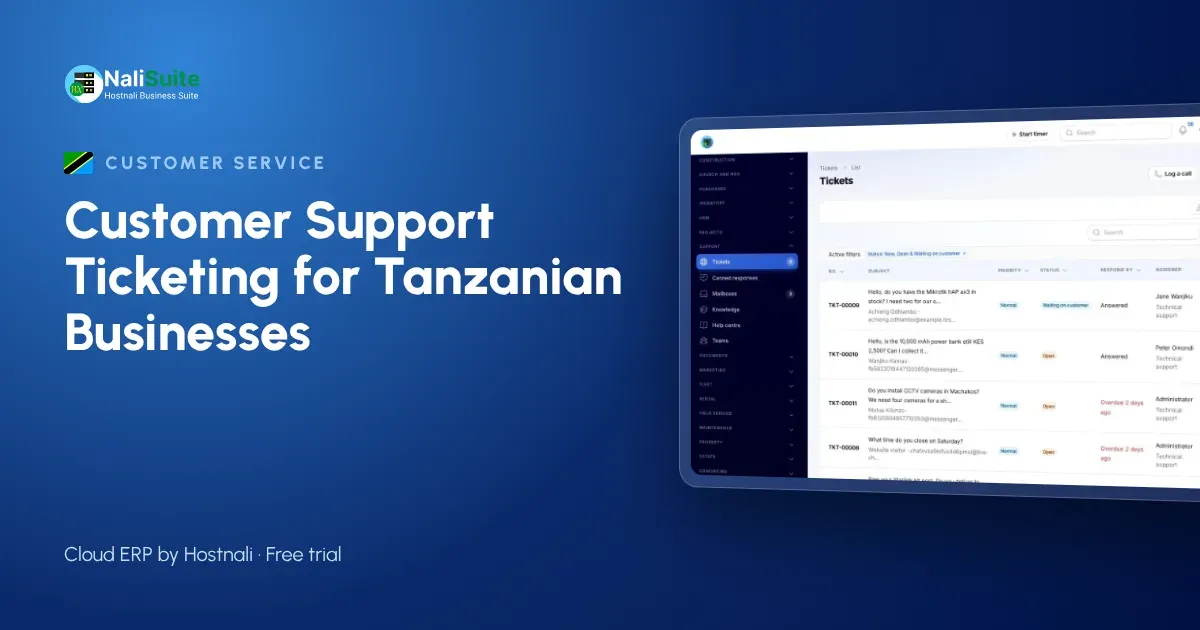
Wholesalers and distributors in Tanzania serve dozens or hundreds of retailers, and every one of them calls, messages or visits with something: a missing item on a delivery, a price question, a request for credit, a damaged bag of cement. These requests are the heartbeat of the business, yet they are usually handled on the sales team’s personal phones.
Here is how a hardware wholesaler in Mwanza moved from scattered phones to a ticket queue, and what changed.
The example: a hardware wholesaler in Mwanza
The wholesaler, based near Kirumba in Mwanza, supplies cement, iron sheets, paint, plumbing and electrical goods to around 200 hardware shops across Mwanza, Geita, Shinyanga and Simiyu. Its customer team is five people, plus drivers who deliver to the regions.
Before ticketing:
- Each salesperson took calls and WhatsApp messages from “their” shops.
- When a salesperson was on leave, their shops’ messages went unanswered.
- Complaints about deliveries reached the manager days later, if at all.
- Nobody knew how many problems were open at any time.
Moving to one queue
The wholesaler connected its channels to NaliSuite Helpdesk: the business WhatsApp number through the WhatsApp Business Cloud API (explained on the WhatsApp feature page), the sales email, the website form and Facebook. Phone calls are logged as tickets by the person who answers.
Every request is now a ticket with an owner, a priority, a status and its full history. Retailers still talk to the same salesperson most of the time, but when that person is away, a colleague sees exactly what was discussed.
Organising the work
Teams
- Orders: new orders, price questions, stock availability.
- Deliveries: delivery times, missing or damaged items.
- Accounts: statements, payments, credit limits.
Tickets within each team are shared out by round robin, which ended the situation where one busy salesperson held thirty open requests.
Priorities
- Urgent: a delivery with the wrong items is at the shop now.
- High: damaged goods, missing items, payment disputes.
- Normal: price questions, order changes, statements.
- Low: product suggestions, general feedback.
Helpdesk tracks first-response and resolution targets per priority and escalates tickets that are about to miss them, so a truck standing at a shop in Geita is dealt with before a price list request.
Quick replies in Swahili and English
Most retailers write in Swahili; some prefer English. The team saved canned replies in both for the questions that come up every day: delivery days for each region, how to pay, how to report damaged goods, credit terms. Any agent can answer accurately in seconds, in the customer’s language.
Longer answers are published as articles in a public help centre and in the customer portal, where retailers can also see their invoices and follow their tickets.
With the AI Business Assistant add-on, AI can draft replies from the conversation and the help articles, using the business’s own Anthropic API key. Staff check and edit every draft before sending.
Linking tickets to orders and money
Most wholesale tickets touch an order or an invoice. Because the helpdesk sits next to sales, NaliSuite Inventory and NaliSuite Invoicing, the agent can check what was ordered, what left the warehouse and what was billed without calling the stores.
Retailers pay by M-Pesa, Airtel Money or card, and mobile money payments are recorded against the invoice, so “have you received my payment?” tickets can be answered at a glance. Keep your invoices in line with what TRA requires of your business.
Common mistakes to avoid
- Letting staff keep using personal numbers for business messages. The history leaves when they do.
- Closing tickets too early. Resolve only when the retailer confirms the problem is sorted.
- No priority rules. Without them, the loudest customer gets served first.
- Not reviewing the numbers. The patterns are where the improvements are.
What the wholesaler found
After two months, ticket data showed that most delivery complaints came from one route to Simiyu, where goods were loaded last and unloaded first. Changing the loading order brought those tickets down sharply. First replies were slowest on Mondays, so a sixth person now helps on Monday mornings.
Customer data
Tickets contain retailers’ names, phone numbers and business details, which are personal data under Tanzania’s Personal Data Protection Act, 2022. Keep them in the helpdesk rather than on personal phones, and give each team access to what it needs.
Retailers in the regions
Shops in Geita, Shinyanga and Simiyu cannot drop into the Mwanza office, so the way their requests are handled matters even more. Tagging tickets by region lets the manager see where complaints cluster and plan delivery routes and stock accordingly. It also shows which regional salesperson needs support, without relying on anecdotes from the drivers.
Frequently asked questions
Can drivers report delivery problems?
Yes. A driver can call or message the business number, and the office logs it as a ticket for the deliveries team.
Can retailers see their own invoices?
Yes. In the customer portal, each retailer sees its own invoices and tickets, and can pay outstanding invoices.
Can we use the same number we already give customers?
Yes. Connect your existing WhatsApp Business number through the Cloud API, and messages arrive in the helpdesk.
Try NaliSuite
Every NaliSuite plan includes Helpdesk, Inventory, Invoicing and the customer portal, from TZS 5,500 a month. See the plans and connect your business number during the free trial.