 TZS
 KES - Kenya
 UGX - Uganda
 RWF - Rwanda
 NGN - Nigeria
 ZAR - South Africa
 USD - Zimbabwe
 GHS - Ghana
 ETB - Ethiopia
 ZMW - Zambia
 USD - International

In Tanzania, SMS and WhatsApp reach almost everyone, so it is fair to ask why a small business should bother with email. The answer depends on who your customers are. A tour operator in Arusha whose clients book from abroad, a supplier in Dar es Salaam selling to companies, or a training institute in Dodoma working with NGOs will find that email is where their customers compare options and make decisions.
This guide explains where email fits next to SMS and WhatsApp, how to build a list legally, what to write in English or Swahili, and how to make sure your emails arrive.
Email, SMS or WhatsApp?
Each channel does a different job. Use them together rather than choosing one.
| Channel | Best for | Example |
|---|---|---|
| Detail, photos, prices, documents | A safari itinerary with prices for next season | |
| SMS | Short reminders anyone can read | “Your service is due tomorrow” |
| Conversations and approved broadcasts | A reminder of a sale to opted-in customers |
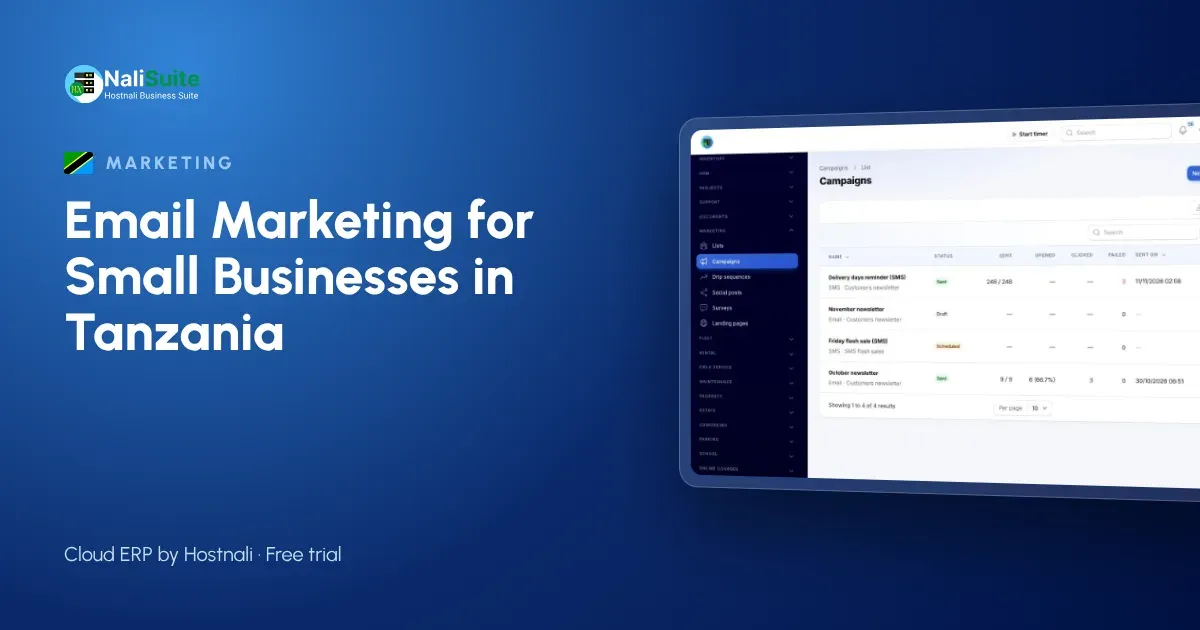
The NaliSuite marketing app handles all three: email campaigns, SMS campaigns through a supported SMS provider, and approved WhatsApp templates to opted-in customers. See also WhatsApp in NaliSuite.
Building a list with consent
Start with your customers
Customers who have bought from you are the warmest audience. They already sit in your records; in NaliSuite, the contacts app. Send them one message asking whether they would like to receive news and offers, and add only those who agree to your marketing list.
Add sign-up points
- a subscribe form or landing page on your website, which feeds your list automatically;
- a tick box on your booking or order form;
- a QR code at reception, on menus or at an exhibition stand in Mwanza or Dar;
- a line on your invoices.
Never buy lists
Bought lists bring complaints and spam filtering, and they ignore the consent the law expects.
Writing in English, Swahili or both
Choose the language your customers use with you. Many businesses keep two segments:
- English for international clients, NGOs and corporate buyers;
- Swahili for local customers and retail buyers.
Write each version for its audience rather than translating word for word. A Swahili subject line that sounds natural will do better than a literal translation of the English one.
What to send each month
A small business can start with two emails a month:
- A useful email, for example travel tips for the long rains, a guide to choosing the right generator or a checklist for an office move.
- A product, service or offer email, with prices or “from” prices in shillings and how to pay, such as M-Pesa, Airtel Money or card.
Add a welcome sequence for new subscribers: three emails over their first week that introduce your business, your most popular product or service, and the questions new customers usually ask. In NaliSuite, drip sequences send these automatically.
Getting into the inbox
Most delivery problems come from a few causes:
- Free webmail senders. Send from your own domain instead. Hostnali’s email hosting gives you business mailboxes, for example [email protected].
- Missing authentication. Set up SPF, DKIM and DMARC records for your domain; our support team can help.
- Unwanted emails. Email only people who agreed, so complaints stay low.
- Bounces. Remove addresses that bounce.
- No easy exit. NaliSuite puts an unsubscribe link in every campaign email and skips people who opt out.
Measuring results
Before each campaign, decide what it should produce: bookings, enquiries, orders or visits. Afterwards, look at:
- opens and clicks, to learn what interests readers;
- replies, which often bring direct enquiries;
- sales that followed. Because marketing, the CRM and sales share customer records in NaliSuite, you can see which contacts clicked and then bought.
Change one thing at a time, such as the subject line or the day you send, and compare.
Example: a lodge near Lake Manyara
A small lodge collects email addresses from guests who agree at check-out. Three months before the next high season, it sends past guests an email with photos of new rooms, a returning-guest offer and a booking button. A week later, an approved WhatsApp template reminds opted-in guests of the offer. Bookings are recorded against each guest, so the lodge can see which campaign brought them back.
The lodge also learns something each season. Guests who stayed in the low season respond to different offers from those who came for the migration, so next year it splits past guests into two segments and writes a separate email for each. The work is the same; the emails simply fit their readers better.
The Personal Data Protection Act
Tanzania’s Personal Data Protection Act, 2022, enforced by the Personal Data Protection Commission (PDPC), applies to the personal data on your marketing list. Collect addresses with clear consent, explain how you will use them, offer an opt-out in every message and act on it. Check the PDPC’s current requirements, including registration, for your business.
Frequently asked questions
Should I email in Swahili or English?
Whichever your customers use with you. Many businesses keep a segment for each.
How often should I send?
Two emails a month is a good start for most small businesses.
Can I send SMS campaigns from NaliSuite?
Yes, once you connect a supported SMS provider to the marketing app.
Is the marketing app an extra cost?
No. It is built in to every NaliSuite plan, from TZS 5,500 a month.
Try NaliSuite
Run email, SMS and WhatsApp campaigns from one customer list. See the NaliSuite plans and start a free trial.