 TZS
 KES - Kenya
 UGX - Uganda
 RWF - Rwanda
 NGN - Nigeria
 ZAR - South Africa
 USD - Zimbabwe
 GHS - Ghana
 ETB - Ethiopia
 ZMW - Zambia
 USD - International

Some Tanzanian businesses run on documents more than on anything else. A clearing and forwarding agent, an insurance broker or a recruitment agency spends much of its day collecting, checking, copying and sending paperwork for clients. For them, going paperless is not about saving paper; it is about speed, because the business that has the right document first wins the next job.
Here is how a clearing and forwarding agent in Dar es Salaam reorganised its paperwork around one idea: a digital folder for every shipment.
The example: a clearing agent in Dar es Salaam
The agency, with an office near the port in Kurasini, Dar es Salaam, has sixteen staff. It handles imports for traders in Kariakoo, manufacturers in the city’s industrial areas and customers in Arusha and Mwanza who ship through Dar. Every shipment comes with commercial invoices, packing lists, bills of lading, permits and payment records.
Before the change, each shipment had a paper file that travelled between desks, with copies made at every step and clients bringing documents in person.
Before and after
| Task | Before | After |
|---|---|---|
| Collecting documents from clients | Client brings copies to the office | Client uploads through a document request |
| Storing shipment papers | Paper file moved between desks | One digital folder per shipment |
| Client agreements | Printed, signed, scanned | Signed online with an audit certificate |
| Supplier and port-related bills | Slips in a tray, typed later | Read by AI into bills for checking |
| Invoicing clients | Typed invoice, printed and delivered | Sent by email or WhatsApp with a pay option |
| Answering “where is my file?” | Search the desks | Search by shipment number or tag |
One folder per shipment
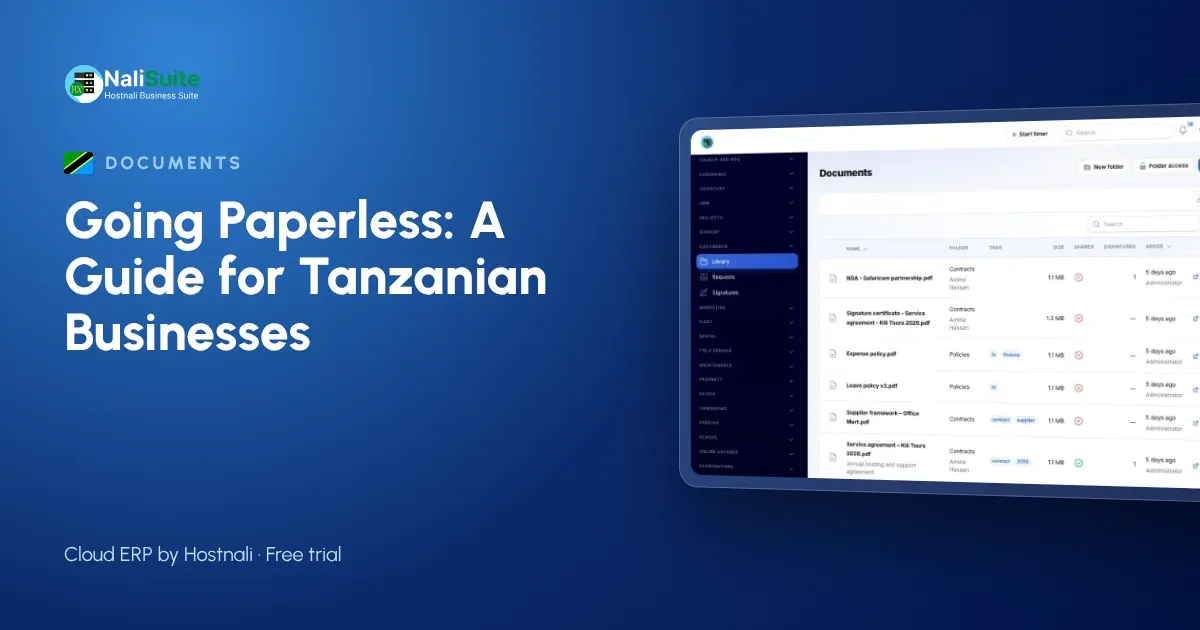
In NaliSuite Documents, every shipment gets a folder named by its reference number, inside a folder for the client. Documents are tagged by type: invoice, packing list, bill of lading, permit, payment. Every version is kept, so when a client sends a corrected packing list, both are there but the latest is clear.
Access is set by role and person. Declarations staff see the shipment folders they work on; only managers see the agency’s own contracts and staff files.
Asking clients for documents
The biggest time saver was document requests. Instead of phoning a trader in Kariakoo and waiting for them to visit, the agent sends a request listing the files needed. The client uploads them through a secure link or the customer portal, and the agency sees at a glance which documents have arrived and which are still missing.
For clients in Arusha or Mwanza, this removed days of courier time from every shipment.
Signing agreements online
Client service agreements and authorisations are sent for e-signature. The client signs on a phone or computer, and the agency receives a stamped PDF with an audit certificate showing who signed, when and from where.
Each signature is recorded with that certificate, which supports its validity. Port, customs and other official processes may still require originals or a particular form of signature, so check the rules for each type of document in Tanzania and keep originals where they are required.
Bills and receipts without retyping
Agency work produces many small bills: transport, handling, storage and other charges paid on behalf of clients. With the Document AI add-on, these receipts and supplier invoices are read and turned into bills or expenses, ready for the accounts team to check. Document AI uses the agency’s own Anthropic API key, so it controls the data and the cost.
Filing a copy of each bill in the shipment’s folder makes it easier to invoice the client for everything paid on their behalf.
Invoicing and getting paid
Invoices are created in NaliSuite Invoicing and sent by email or WhatsApp. Clients pay by M-Pesa, Airtel Money, card or bank transfer, and mobile money payments are recorded against the right invoice. Keep your invoices in line with what TRA requires of your business.
In the customer portal, clients see their invoices, pay outstanding ones and download the documents shared with them, such as release documents and receipts.
Making it stick
The agency set four rules in its first week:
- Nothing is saved on a personal computer or phone; everything goes into the shipment folder.
- Every document is tagged on upload.
- Clients are asked for documents by request, not by phone.
- Old paper files are boxed by year and scanned only when needed.
What changed
Within two months, staff stopped walking files between desks, clients outside Dar stopped couriering papers, and the “where is my file?” question was answered in seconds by searching the shipment number.
Personal data
Shipment files hold client names, contacts and ID documents, which are personal data under Tanzania’s Personal Data Protection Act, 2022. Digital folders with access control are easier to protect than open shelves, so give each person access only to what they need.
Frequently asked questions
Can clients upload documents from their phones?
Yes. Document requests work through a secure link or the customer portal, on a phone or computer.
Do we still need paper originals?
For some official processes, yes. Keep originals where they are required and store digital copies for everything else.
Can we see which documents are still missing?
Yes. Document requests show what has arrived and what is outstanding.
Try NaliSuite
Documents, Invoicing and the customer portal are part of every NaliSuite plan, from TZS 5,500 a month. See the plans and open your first shipment folder during the free trial.