 TZS
 KES - Kenya
 UGX - Uganda
 RWF - Rwanda
 NGN - Nigeria
 ZAR - South Africa
 USD - Zimbabwe
 GHS - Ghana
 ETB - Ethiopia
 ZMW - Zambia
 USD - International

From Kariakoo in Dar es Salaam to the markets of Mwanza and Arusha, Tanzanian traders are some of the sharpest negotiators anywhere. Yet many small businesses still struggle to make a profit, because the price they negotiate down to is not based on a clear view of what the goods cost. A good price starts long before the customer walks in.
This guide gives you a straightforward way to price products, protect your margin and avoid the habits that quietly drain profit.
Know the number you must never go below
Every product has a break-even price: the point at which you neither make nor lose money on it. To find it, count all of the costs, not just the supplier price:
Getting the goods
- Supplier or factory price.
- Transport from Dar es Salaam to upcountry towns, or from the port for imports, with clearing and duty.
- Loading, offloading and storage.
Selling the goods
- Packaging and bags.
- Charges you pay to accept M-Pesa, Airtel Money or card payments.
- Damage, theft and expiry.
Running the business
- Rent, staff, electricity, security and data.
- Your own salary.
Running costs are shared across all the units you sell in a month. Add the share to the direct costs and you have the break-even price per unit.
Decide how much profit each product should make
Many owners add a fixed amount or a fixed percentage to every product. That is simple, but it can price fast movers too high and slow items too low.
A better approach is to group products:
- Basic goods that people buy often and compare closely: keep the margin modest.
- Regular goods: use your normal target margin.
- Special items that sell slowly or need explanation: use a wider margin.
Remember the difference between markup and margin. If you want to keep 30% of the selling price, do not add 30% to the cost. Divide the cost by 0.7 instead.
Place VAT correctly
If your business is registered for VAT, the standard rate in Tanzania is 18%, and it is collected on behalf of TRA. Your profit is what remains after taking VAT out, so always work margins on prices before VAT. For business customers, show VAT separately on the invoice. Our free VAT calculator splits any price into its VAT and non-VAT parts.
Separate retail and wholesale
Selling one item to a walk-in customer and selling a hundred cartons to another shop are different jobs. Give each its own price list:
| Price list | Who it is for | Typical rule |
|---|---|---|
| Retail | Individual buyers | Standard price |
| Wholesale | Shops and resellers | Lower price above a minimum quantity |
| Projects | Contractors, hotels, institutions | Quoted price with payment terms |
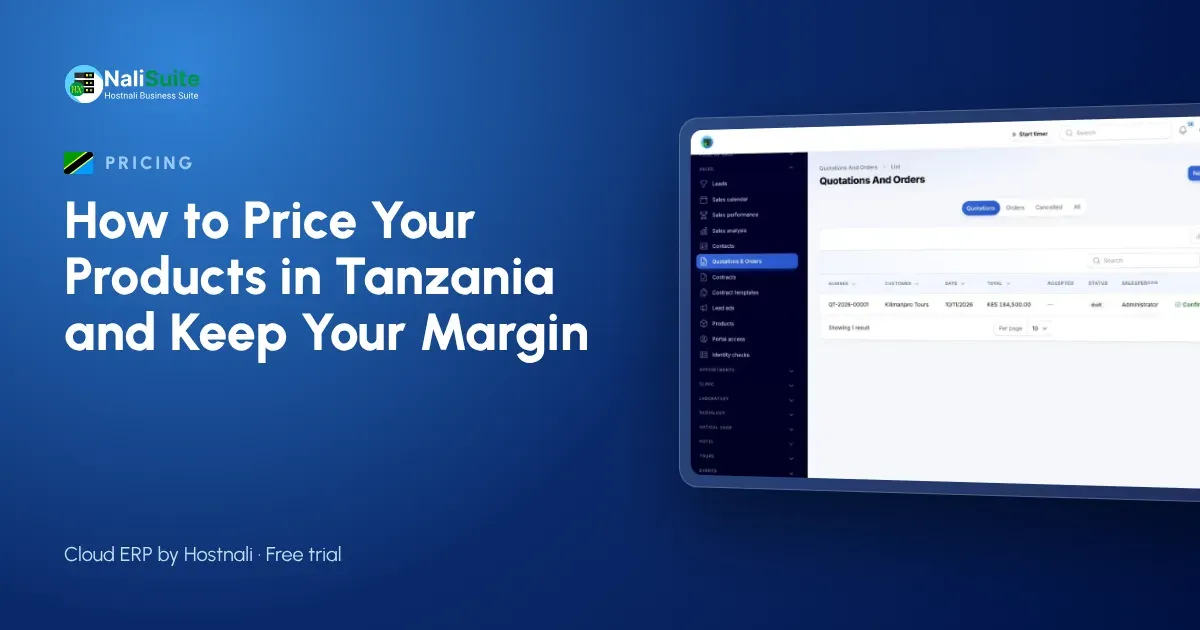
In NaliSuite, the sales app keeps price lists by customer group or quantity, and quotations pick up the right one automatically. At the counter, the point of sale uses the same lists and can send an M-Pesa prompt to the customer’s phone.
A worked example
A shop in Mwanza sells a sample solar lantern. Using plain example numbers:
- Supplier price in Dar es Salaam: 28,000.
- Transport to Mwanza and handling: 2,000.
- Share of losses: 500.
- Share of running costs: 2,500.
- Break-even price: 33,000.
For a 25% margin before VAT: 33,000 ÷ 0.75 = 44,000. Resellers ordering twenty or more lanterns pay 39,000, a margin of about 15%, which still leaves room for the shop to cover its costs.
Avoid three common habits
- Pricing from memory. Write prices down and keep them in one system.
- Letting every staff member bargain. Set the lowest price anyone may accept, and make bigger discounts need approval.
- Keeping old prices after costs rise. Update your cost every time new stock arrives.
Keep checking
Costs in Tanzania can change with fuel prices, the exchange rate and supplier price lists. Make margin checks a monthly habit. NaliSuite inventory records the landed cost of each delivery, with freight added to the cost of goods, and accounting shows gross margin by product and period, so you know which prices to change.
When you raise a price, update it everywhere on the same day: the till, the price list, quotations and your online shop.
Pricing for hotels and lodges
Around Arusha, Zanzibar and the national parks, hotels and lodges buy food, linen, cleaning supplies and spare parts in volume. They value reliable delivery and consistent quality more than the lowest price, and they usually pay on account. Give them a contract price list valid for a set period, agree delivery days, and price in the cost of transport to remote lodges and the time you wait to be paid. A dependable supplier who delivers on time is worth more to a lodge than a cheaper one who often lets them down.
Frequently asked questions
How do I price goods I bought at different costs?
Use average cost or first-in-first-out costing so each sale uses the right cost. NaliSuite supports both.
Is it fine to sell below cost to clear old stock?
Sometimes, for stock that will expire or go out of date. Treat it as a planned clearance, not a habit.
What if customers say my price is too high?
Explain what they get – quality, warranty, delivery, reliable stock – or offer a smaller pack. Do not drop below break-even.
Try NaliSuite
NaliSuite connects your stock costs, price lists, quotations and till so every price protects your margin. Plans start at TZS 5,500 a month, shown in shillings, with a free trial. Compare the plans.