 TZS
 KES - Kenya
 UGX - Uganda
 RWF - Rwanda
 NGN - Nigeria
 ZAR - South Africa
 USD - Zimbabwe
 GHS - Ghana
 ETB - Ethiopia
 ZMW - Zambia
 USD - International

Cooperatives in Tanzania handle some of the country’s most important crops, from coffee on the slopes of Kilimanjaro to cashew in the south and milk in the highlands. Members need to know that what they deliver is recorded fairly and that what they are paid is correct. This guide covers the records and routines that make that possible.
A worked example: a coffee society near Moshi
Picture a primary coffee society near Moshi whose members deliver parchment coffee during the season. Each delivery is weighed and graded, and members may have taken fertiliser or pesticide on credit earlier in the year. The society often pays members in instalments as the coffee is sold. When every delivery, credit item and instalment is recorded against the member, the society can tell any member at any time what they have delivered, what they owe and what is still due.
Weigh, grade and confirm each delivery
Members judge the cooperative at the scale. Weigh every delivery in front of the member, record the grade or quality check, and confirm the entry with a text message to the member’s phone before they leave.
The same record drives the payout, the stock received into the store and the figures you report to your buyer, so a delivery is only ever entered once.
Start with a clean member register
Everything else depends on the register. Give every member a number, and record their name, phone, payment details, the route or collection centre they use and the date they joined. Add next of kin, because a member’s family will need to be paid if the member dies or falls ill.
Review the register once a season. Mark members who have stopped delivering as inactive rather than deleting them, so their history and any balance they still owe stay on record.
Payday: from deliveries to money in members’ hands
On payday the steps should be routine: close the period, check the totals against what your buyer paid, approve the payout list and pay members by M-Pesa or Airtel Money.
Keep the approval with two people, such as the treasurer and the chair, so no single person can change the list and pay it.
Credit from the cooperative store
Run the cooperative store like a shop that sells on account. Goods leave stock, the member’s account is charged, and the balance is recovered from their next payout.
Because stock and member accounts are linked, the store manager knows what is left on the shelf and the treasurer knows what members owe, without comparing two notebooks.
Agree the deductions and show every one
Before the season starts, agree in writing which deductions apply: store credit, advances, a levy, share capital, savings contributions or loan repayments. Then show each one separately on the statement, never as a single lump.
A member who can see ‘feeds’, ‘share capital’ and ‘loan repayment’ as three lines understands where their money went. A member who sees one unexplained deduction assumes the worst.
Paying members by M-Pesa
In Tanzania many members prefer to be paid by M-Pesa or Airtel Money. Confirm numbers at registration, and keep the member’s name as registered on the mobile money account, so that the name shown on the payout matches.
Share statements by text or WhatsApp in Swahili where that is what members read most comfortably. A clear statement in a familiar language does more for trust than any meeting.
Doing it in NaliSuite
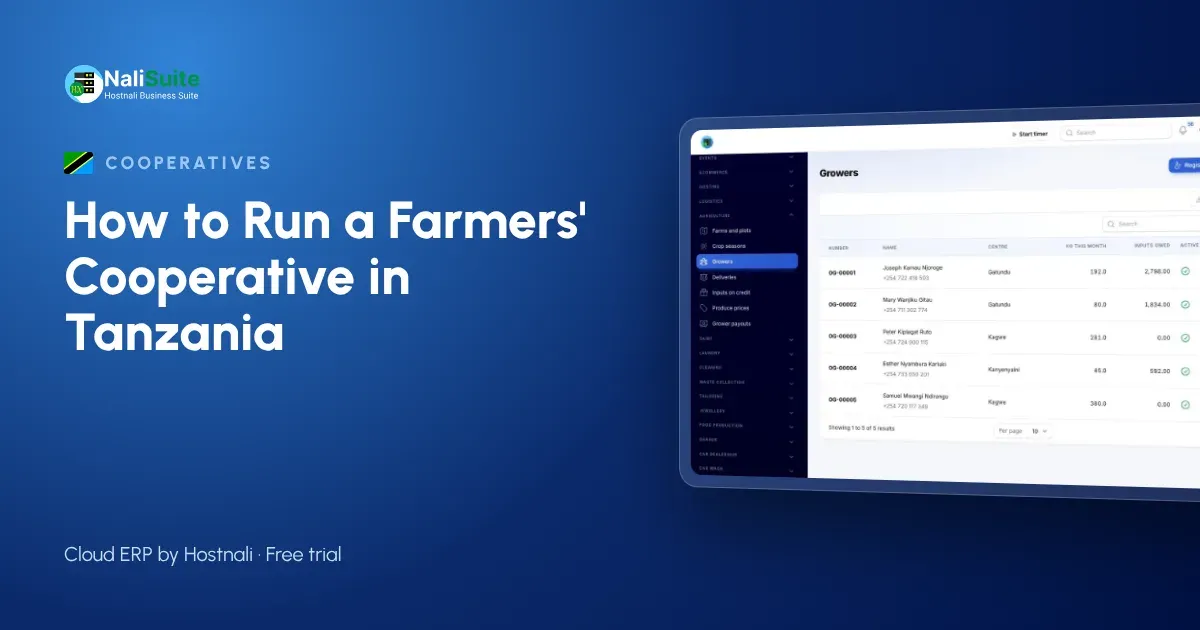
You do not need to build this from scratch. In NaliSuite, the Agriculture and Outgrowers add-on registers the growers who supply you, records weighed collections priced by grade with a text receipt, and settles inputs given on credit in each payout. Dairy groups use the Dairy Cooperative Milk Collection add-on for routes, intake with density rejection, store credit and monthly payouts.
The SACCO and Microfinance add-on adds member savings, share capital and loans, and members can see statements in a portal. The store’s stock lives in Inventory, the books in Accounting, and the farms and cooperatives page shows how they fit together.
Reporting to members and the board
Members want their own statement; the board wants the whole picture. Produce both from the same records: a statement per member after each payout, and a summary of deliveries, sales, deductions and payouts for the board.
Keep the books for the cooperative itself in the same system, so the annual accounts come straight from the records members already see.
Member records are personal data. Keep them secure, use them only to run the cooperative and follow the Personal Data Protection Act, 2022, overseen by the Personal Data Protection Commission.
Frequently asked questions
Can payouts go to M-Pesa?
Yes. Payouts can be sent to members’ M-Pesa or Airtel Money numbers, and each payment is recorded against their statement.
Can we pay members in instalments?
Yes. Each instalment is recorded against the member’s deliveries, so the balance still owed is always clear.
Will it work at collection points with weak internet?
Clerks can record deliveries on a phone or laptop in the browser; plan for a working connection at each centre, or record at the main office the same day.
How long does it take to set up?
Most cooperatives start with the member register and one collection point, then add the others once the first is running smoothly.
Try NaliSuite
Start a free trial, import your member list and record a week of deliveries at one collection point. You will see the first statements before month end. See the plans.