 TZS
 KES - Kenya
 UGX - Uganda
 RWF - Rwanda
 NGN - Nigeria
 ZAR - South Africa
 USD - Zimbabwe
 GHS - Ghana
 ETB - Ethiopia
 ZMW - Zambia
 USD - International

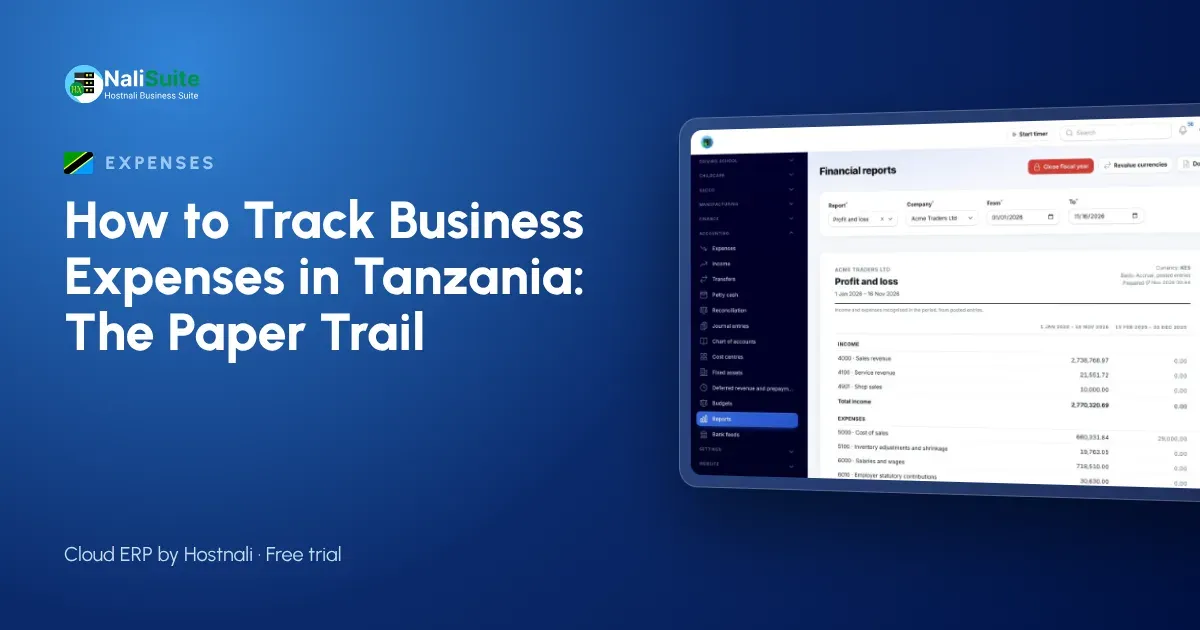
Good expense tracking in Tanzania comes down to one idea: every shilling that leaves the business should leave a trail. A receipt, a bill, an M-Pesa confirmation, a voucher – something that shows what was paid, to whom and why. When the trail is complete, month end is easy, tax questions have answers and the owner can see exactly where costs are rising.
This guide shows how to build that paper trail, digital or physical, for a small Tanzanian business.
The documents that make up the trail
| Document | When you get it | Why it matters |
|---|---|---|
| EFD receipt | Buying from a business that uses an electronic fiscal device | Shows the supplier, amount and tax; supports VAT claims if you are registered |
| Supplier tax invoice | Buying on account | The bill you pay later; keep it with the payment |
| M-Pesa or Airtel Money confirmation | Paying by mobile money | Proves the payment; add a purpose |
| Bank advice or statement line | Paying by transfer | Proves the payment |
| Petty cash voucher | Small cash payments with no receipt | Shows purpose, amount and who received it |
| Expense claim | A staff member paid for the business | Links their receipt to repayment |
Ask suppliers for an EFD receipt whenever they should issue one. TRA expects businesses to keep proper records of expenses, so check the current requirements with TRA for your type of business.
Rule 1: Link every payment to a document
A payment without a document is hard to explain later. A document without a payment may be a bill still owed. Each expense in your books should have both: the receipt or bill, and the payment that settled it.
When you pay by M-Pesa, use the supplier’s paybill or till number and put the invoice number or purpose in the account field. When you pay by bank, include it in the narration.
Rule 2: File on the day
Receipts fade, get wet and get lost. EFD receipts printed on thermal paper are especially easy to lose, because the print disappears over time. Photograph them the day you receive them, and store the photo alongside the paper.
A simple filing approach:
- One folder or envelope per month for paper.
- One digital folder per month for photos, named by date and supplier.
- Supplier bills filed with their payment once paid.
NaliSuite documents keeps files in organised folders with access by role, version history, tags and search, so a receipt from March can be found in seconds.
Rule 3: Approve before paying
For anything above a small daily amount, approval should come first. Decide who approves what and stick to it. In NaliSuite purchases, purchase orders, bills and expenses can carry approval rules by amount, and supplier bills are checked against what was ordered and received before payment.
Rule 4: Make staff claims simple
Staff who travel or buy small items need a quick way to claim. With NaliSuite employee self-service, they take a photo of the receipt and submit the claim from their phones; managers approve and the claim moves to payment. The receipt is attached to the claim from the start, so the trail is complete.
Rule 5: Reconcile every month
Reconciliation is the final check. Go through your bank, M-Pesa and Airtel Money statements and match every payment to a recorded expense. Then check that every recorded expense has a payment. Anything left unmatched needs a document or an explanation.
NaliSuite accounting imports statements or connects bank feeds and suggests matches, and bank and M-Pesa reconciliation lists what is still open.
Less typing, fewer mistakes
Typing supplier bills by hand is slow and error-prone. The Document AI add-on reads PDFs and phone photos of bills and receipts – supplier, invoice number, dates, lines, VAT and totals – and drafts the bill or expense for you to approve. It connects with an Anthropic API key in your business’s name.
An example from Dodoma
A sample construction supplier in Dodoma used to keep receipts in a shoebox and pay suppliers from the owner’s personal M-Pesa line. At year end, the accountant could not match many payments to bills. The business moved to a dedicated business line, began photographing receipts daily and reconciling monthly. The next year end took days instead of weeks, and the owner could see which projects were costing more than they earned.
Separate business and personal lines
Keep a dedicated business M-Pesa line and bank account, and pay yourself from them on a fixed day. Personal spending then never enters the business records.
Frequently asked questions
What should I do about faded EFD receipts?
Photograph receipts on the day you get them, so you have a readable copy even if the paper fades.
Do I need a receipt for every small payment?
Get one wherever the seller can issue it. Where they cannot, use a signed petty cash voucher.
Can I track expenses paid from my personal phone?
Better not. Use a business mobile money line so business and personal payments stay separate.
Try NaliSuite
NaliSuite links receipts, bills, claims, approvals and M-Pesa reconciliation in one place. Plans start at TZS 5,500 a month, shown in shillings, with a free trial. See the plans.