 TZS
 KES - Kenya
 UGX - Uganda
 RWF - Rwanda
 NGN - Nigeria
 ZAR - South Africa
 USD - Zimbabwe
 GHS - Ghana
 ETB - Ethiopia
 ZMW - Zambia
 USD - International

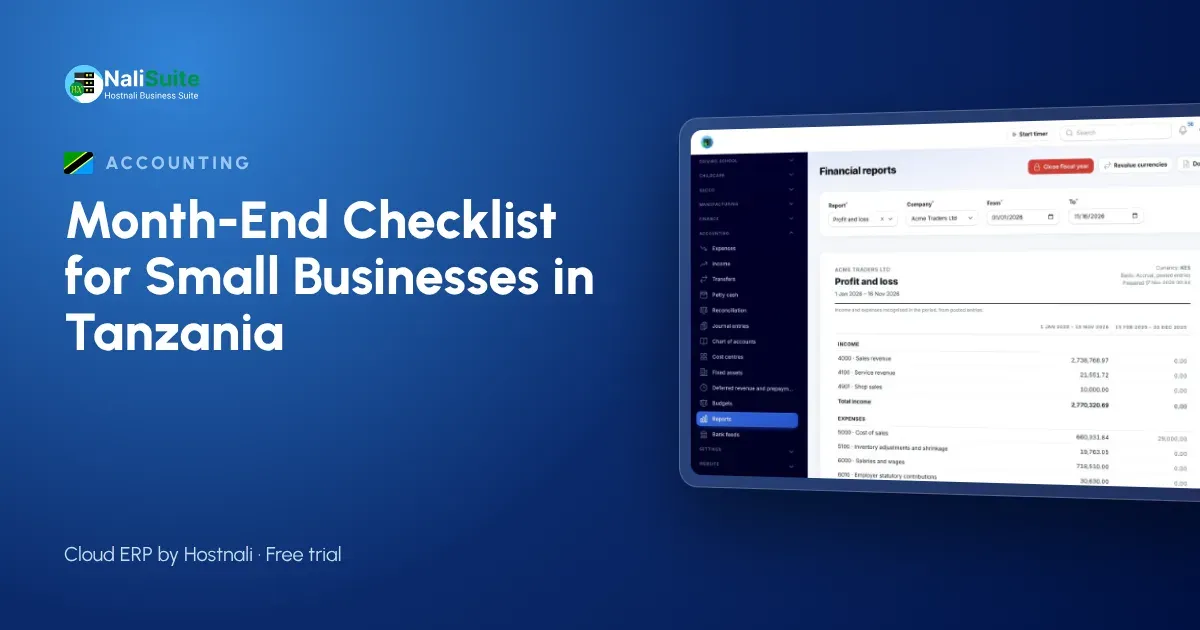
For a shop in Arusha or a transport company in Dar es Salaam, the first week of the month comes with deadlines. PAYE and SDL are due to TRA by the 7th, and the records behind those figures have to be right.
This guide is built around the errors that cause most month-end trouble in Tanzanian small businesses. For each one you get the reason it happens and a simple fix. A short checklist at the end puts it all together.
Error: the M-Pesa statement and the sales book never agree
Customers pay by M-Pesa, Airtel Money, bank and cash. Staff take payments on more than one number. At month end, the wallet shows one figure, the sales book another.
Why it matters: Unrecorded sales mean your profit, VAT and stock are all wrong.
What to do:
- Export the statement for every M-Pesa and Airtel Money number the business uses.
- Link each payment to a sale or invoice.
- List the payments you cannot place and follow them up before the close.
NaliSuite Accounting imports bank and mobile money statements and suggests the matching invoice for each line. The reconciliation feature explains the process.
Error: bills are entered when they are paid
Many businesses record a supplier bill only on the day they pay it. A bill for goods delivered in March but paid in April then lands in April.
Why it matters: One month looks profitable, the next looks poor, and neither is true.
What to do: Record each bill with the date the goods or services were received. Gather bills from email and WhatsApp as well as paper, and include wallet and bank charges.
Error: nobody looks at who owes money
Small businesses often know their regular customers well and let balances run. Then one customer disappears with a large unpaid amount.
Why it matters: Credit is a loan you give for free. The longer it runs, the less likely you are to be paid.
What to do: At each close, list unpaid invoices from oldest to newest. Remind customers whose invoices are just overdue, call those further behind and stop new credit for anyone well past the limit you agreed. With NaliSuite Invoicing, every reminder includes a link to pay by M-Pesa, Airtel Money or card. The mobile money payments page shows how those payments match themselves to the invoice.
Error: stock counts happen once a year
Why it matters: Losses from damage, theft or receiving mistakes build up quietly.
What to do: Count your most valuable and fastest-selling items monthly. Write down each difference with a reason. If the same item is short month after month, look at how it is received and sold.
Error: payroll deductions are worked out in a hurry
With the PAYE and SDL deadline on the 7th, payroll checks are often skipped.
Why it matters: A wrong deduction affects the employee, your return to TRA and your NSSF schedule.
What to do: Compare this month’s payroll with last month’s and explain every change. Record PAYE, SDL, NSSF and the Workers Compensation Fund contribution as amounts owed until they are paid. NaliSuite’s Tanzanian payroll calculates these, and the free PAYE calculator checks one salary at a time.
Error: VAT is prepared from half the records
Why it matters: A VAT return based on incomplete figures will need correcting, and corrections take time.
What to do: If you are registered for VAT, the standard rate is 18%. Prepare the VAT figures only after sales, bills and payments are complete. Check that each sale was recorded with the correct rate and that input VAT is backed by a valid tax invoice. Confirm current filing dates and receipting rules with TRA.
Error: the month is never closed
Why it matters: Without a lock, anyone can post into an old month and change figures you have already used.
What to do: After reading the reports, lock the period. If a correction is needed, reopen it deliberately and note why.
The checklist
- Wallet, bank and cash matched.
- Supplier bills recorded with delivery dates, fees included.
- Unpaid invoices reviewed, reminders sent.
- Key stock counted, differences recorded.
- Payroll compared with last month; PAYE, SDL, NSSF and WCF recorded.
- VAT figures prepared.
- Profit and loss, balance sheet and unpaid invoices reviewed.
- Month locked.
A worked example from Mwanza
A fish supplier in Mwanza with two trucks and seven staff took most payments by M-Pesa. At the first proper close, the owner found that drivers had been collecting payments on their personal numbers and sending the money on later, minus fees nobody recorded. The business moved to one company till number. The next month, M-Pesa income matched the delivery notes almost exactly.
Frequently asked questions
When should the close be finished?
Aim to finish payroll checks before the 7th so PAYE and SDL can be paid on time, and the rest within the first week.
Should drivers and sales staff take payments on their own numbers?
It is better not to. A company till or paybill number puts every payment in one statement and removes the need to chase staff.
How do I treat M-Pesa charges?
As a business expense. Record the full sale as income and the charge as a cost.
Can the close be done without an accountant?
The routine steps, yes. An accountant should review the reports regularly and handle year-end accounts.
Try NaliSuite
NaliSuite gives Tanzanian businesses invoices with M-Pesa pay links, statement matching, statutory payroll and accounting in one system. Try it free; plans start at TZS 5,500 a month. See the plans or read about NaliSuite.