 TZS
 KES - Kenya
 UGX - Uganda
 RWF - Rwanda
 NGN - Nigeria
 ZAR - South Africa
 USD - Zimbabwe
 GHS - Ghana
 ETB - Ethiopia
 ZMW - Zambia
 USD - International

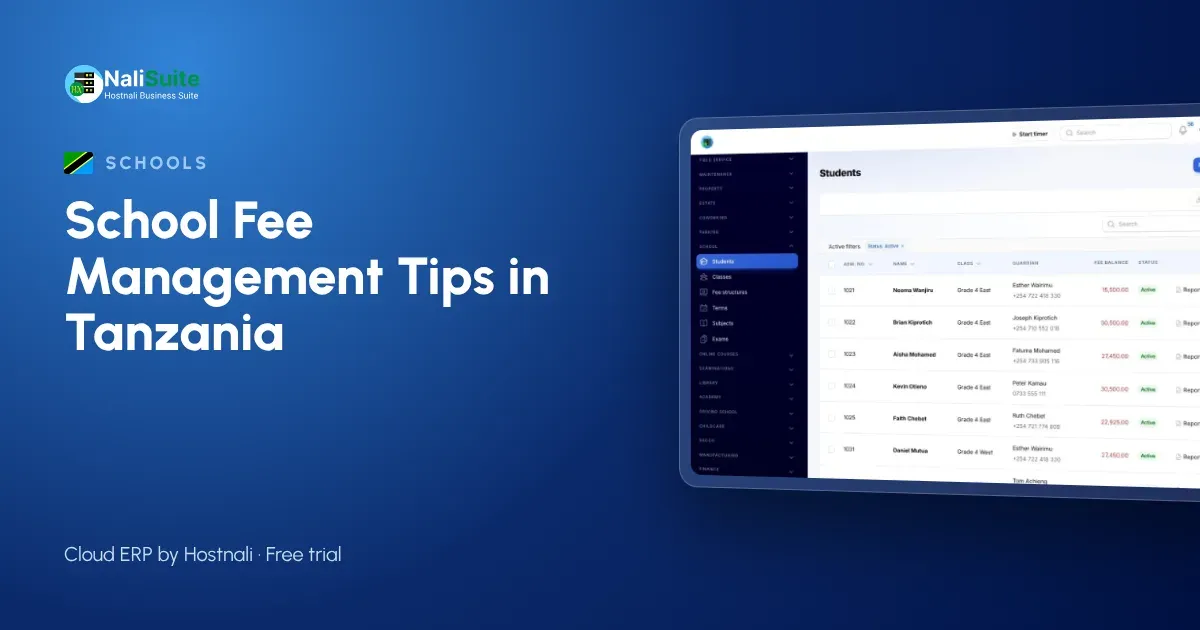
Private schools in Tanzania collect fees from parents who pay by M-Pesa, at the bank and sometimes in cash. Keeping track of who has paid what is the bursar’s daily challenge.
Here is a practical way to organise it.
Notes for Tanzanian schools
Parents often pay by M-Pesa or Airtel Money in instalments. Payments against an invoice, with a reference, make matching automatic and receipts accurate.
Student data is personal data under the Personal Data Protection Act, 2022; keep access to fees and contacts to the people who need it.
Agree the rules before the first invoice
Instalments, sibling discounts and late balances cause the most disputes, so decide them in advance. Put the rules in a one-page fee policy approved by the board, send it with the admission letter and repeat the key dates on every invoice. Staff can then apply the same rules to every family instead of negotiating case by case.
Send invoices before parents ask
A parent who has to call the office to find out what they owe will pay later than one who already has an invoice. Bill early and give each family one document for each child, with the items, discounts and balance carried forward.
Term invoices are raised from the fee structure in one click and can be sent with a pay link, so paying is a tap on the phone rather than a trip to the bank.
Track balances and remind early
Collecting fees is about rhythm: invoice, remind before the due date, remind again after it, then call. A list of balances by class shows the bursar who to contact first.
Parents can pay online through your payment gateways by M-Pesa or Airtel Money, card or bank transfer, and each payment is matched to the child’s invoice. Gentle reminders with the same pay link go out on the schedule you choose, and SMS or email campaigns from Marketing can reach a whole class at once.
Common problems and how to fix them
| Problem | Fix |
|---|---|
| Parents dispute balances | Statements showing every invoice and payment |
| Payments cannot be matched | Pay links and invoice references |
| Late invoices | Term invoices raised in one click from the fee structure |
| Office overwhelmed at term start | Invoices sent before opening day |
| Salaries paid late | Daily view of collections next to payroll |
Example: an English-medium school in Arusha
An English-medium primary school in Arusha replaced its receipt books with term invoices from fee structures per class. Parents pay by M-Pesa with a pay link, and payments are matched to the child automatically. The owner sees collections and salaries side by side.
Put the fee schedule in one place
When fees live in a document, a spreadsheet and the bursar’s memory, they drift apart. Write the schedule once, per level and per term, and make it the only source the office uses.
With the School Management add-on, each level has its fee structure, and siblings or bursary students get their discount on the invoice. Any change applies to every child in that level from the next term.
Bring results and fees together
Report cards and fee statements usually come from different places, which means two systems to maintain. Keeping both on the same student record saves effort and gives parents one place to look.
The School Management add-on records exams and marks and produces report cards with grades and positions; the Exams add-on adds timetables, seating, question banks and online papers. Parents see results and balances in the portal.
Connect fees to salaries and the books
Boards want simple answers: how much was collected, how much is owed, and can we pay staff this month? Those answers come easily when fees, payroll and accounting share one system.
Fee receipts and salaries both post to the ledger, payroll runs through Payroll with payslips sent to staff, and term reports show income per level next to costs.
Your first term on a new system
Before term: import students, guardians and opening balances, and set fee structures per level. First week: send term invoices with a pay link so parents can pay by M-Pesa or Airtel Money, card or bank transfer. Mid-term: send reminders to balances by class. End of term: carry balances forward and review collections against salaries.
Frequently asked questions
Can parents pay by M-Pesa?
Yes. Parents pay by M-Pesa, Airtel Money, card or bank transfer and each payment is matched to the invoice.
Can we run payroll with NSSF and SDL?
Yes. Payroll works out PAYE, NSSF and SDL and produces payslips and schedules.
Is the school module an extra cost?
School Management and Exams are add-ons to any NaliSuite plan, so you pay only for what you use. Plans start from TZS 5,500 a month.
Can we start in the middle of a term?
Yes. Import students and opening balances, set the fee structure for the next term and carry the balances forward.
Try NaliSuite
If your fee book is still on paper or in a spreadsheet, NaliSuite gives the bursar one place for invoices, payments, balances and salaries. Explore the schools industry page and choose a plan from TZS 5,500 a month; every plan starts with a free trial.