 TZS
 KES - Kenya
 UGX - Uganda
 RWF - Rwanda
 NGN - Nigeria
 ZAR - South Africa
 USD - Zimbabwe
 GHS - Ghana
 ETB - Ethiopia
 ZMW - Zambia
 USD - International

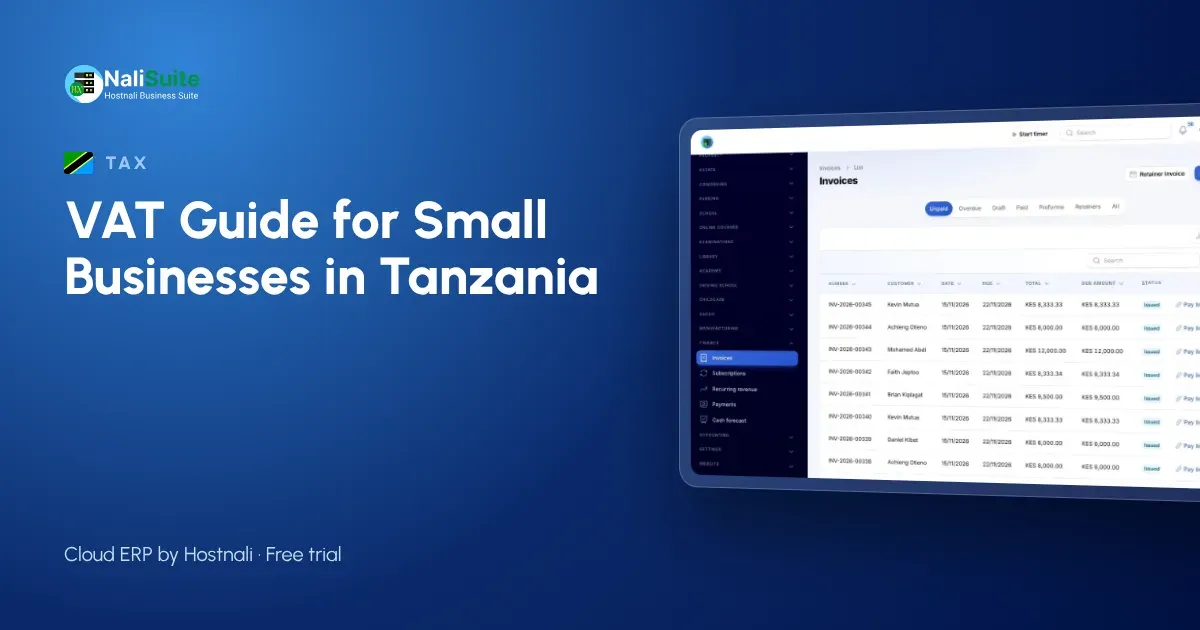
Whether you sell spare parts in Dar es Salaam or run tours from Arusha, VAT at 18% is one of the biggest numbers on your invoices. This guide walks through how Tanzanian businesses handle it with the Tanzania Revenue Authority (TRA).
Two calculations you’ll use every day
Adding VAT to a net price: TZS 750,000 × 1.18 = TZS 885,000, with TZS 135,000 of VAT.
Finding the VAT inside a total: TZS 236,000 ÷ 1.18 = TZS 200,000, leaving TZS 36,000 of VAT.
Mainland and Zanzibar can differ in how tax is administered, so confirm your position with TRA or the relevant authority. Then the free VAT calculator gives you exact figures.
Receipts and EFDs
TRA requires electronic fiscal devices (EFDs) or approved systems for issuing receipts and invoices in many cases. Check TRA’s current rules for your business. Your invoices themselves should show your TIN, a unique number, the date, the items and the VAT separately. NaliSuite Invoicing handles the numbering and per-line tax.
M-Pesa and Airtel Money payments
Most of your customers probably pay by M-Pesa or Airtel Money. That’s fast, but it can leave you with a list of payments and no clear link to invoices. NaliSuite’s mobile money payments attach a pay link to each invoice, so payment and invoice are matched without anyone checking SMS messages.
Input VAT
You can usually deduct the VAT you pay on business purchases from the VAT you collect, with valid invoices from your suppliers. Tour operators, for example, buy fuel, park services and accommodation; each valid invoice reduces the VAT bill.
Returns
The return sums output VAT and input VAT for the period. If your invoices and bills are in NaliSuite Accounting, the VAT report gives you the totals; you file with TRA. Check TRA for the filing date.
A worked month for an Arusha tour operator
A sample tour operator in Arusha sells safari packages to visitors and day trips to residents. Its costs include vehicle fuel, park fees, accommodation and guides. Some of these purchases carry VAT and some don’t. Recording each bill with its correct tax treatment means the VAT report shows exactly what can be claimed.
Packages paid by foreign visitors can be treated differently from local sales, so the operator’s accountant confirms the treatment with TRA before the season starts.
Pricing in shillings and dollars
Many Tanzanian businesses quote tourists in US dollars and local customers in shillings. NaliSuite keeps price lists in more than one currency, and each invoice records the currency used. Check TRA’s rules on currency for VAT returns before you mix them.
Setting aside VAT
With 18% of each taxable sale belonging to TRA, a weekly transfer of the VAT portion into a separate account keeps it safe until the return.
Second example: a Mwanza supplier’s credit sale
A sample fish exporter’s supplier in Mwanza sells nets and boat equipment on account. The invoice carries 18% VAT on the taxable items and a due date 30 days later. The VAT may be due when the invoice is issued, depending on the rules that apply, so the supplier follows up the payment promptly instead of waiting.
A checklist before your return
- All invoices and receipts for the month are recorded.
- Supplier invoices for claimed VAT are valid and filed.
- M-Pesa and bank receipts are matched to invoices.
- The VAT report has been reviewed by someone else.
Records TRA may ask for
Keep every invoice, receipt, supplier invoice, credit note and bank or mobile money statement for each period, together with your return workings. When TRA asks about a figure, you should be able to show the documents behind it. Recording everything in NaliSuite as it happens means the documents are linked to the transactions.
Training whoever invoices
If staff issue invoices for you, make sure they know which products carry VAT, how to record a customer’s TIN and how to correct a mistake with a credit note. A one-page guide at the counter prevents most errors.
When to ask an adviser
Ask an accountant to review your settings when you register and when TRA changes rules.
Frequently asked questions
What is the VAT rate in Tanzania?
This guide uses 18%, the standard rate. Some supplies are exempt.
Does NaliSuite replace an EFD?
NaliSuite issues invoices and receipts with VAT per line. Check with TRA what device or system you must use.
Can I track VAT for each branch?
Yes. Sales from each shop or branch carry their own VAT, and you can report per branch.
Do I charge VAT to customers in Zanzibar?
Rules can differ between the mainland and Zanzibar. Check with the relevant authority.
Can I see VAT by branch?
Yes, if each branch is set up as its own location in NaliSuite.
Should quotations show VAT?
Yes, so customers see the full price before they accept.
Try NaliSuite
18% VAT on every line, M-Pesa matched to invoices and VAT figures each month, from TZS 5,500 a month. See plans.