 TZS
 KES - Kenya
 UGX - Uganda
 RWF - Rwanda
 NGN - Nigeria
 ZAR - South Africa
 USD - Zimbabwe
 GHS - Ghana
 ETB - Ethiopia
 ZMW - Zambia
 USD - International

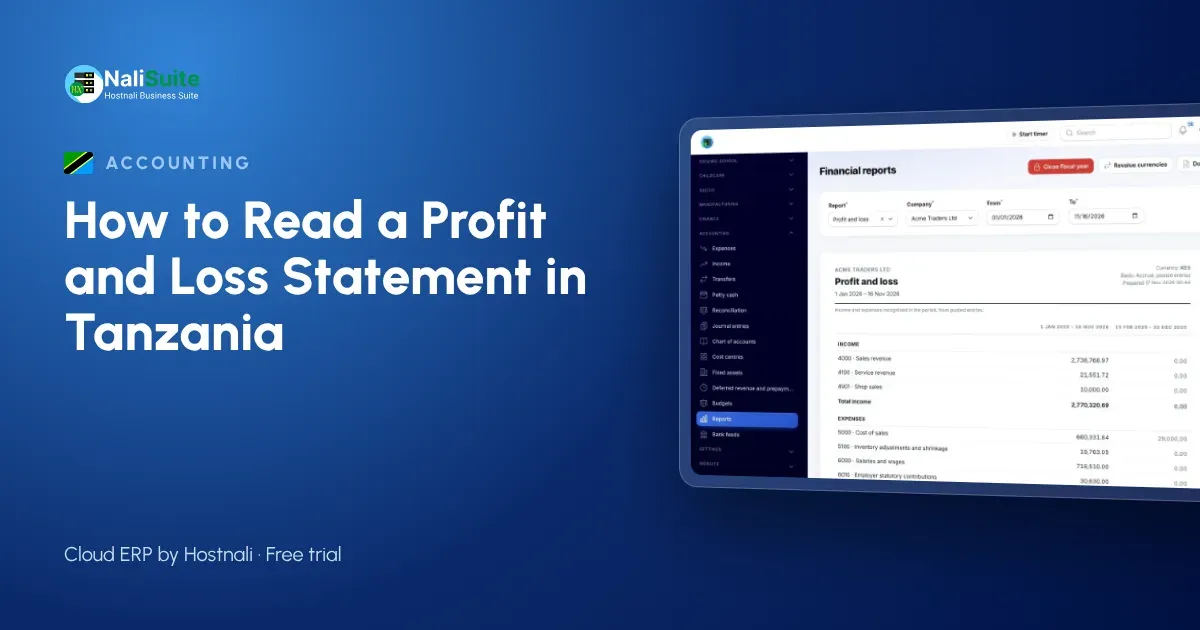
Sooner or later, someone outside your business will read your profit and loss statement: a loan officer, a partner who wants to invest, a large customer checking that you can deliver a contract, or a buyer if you ever sell. They read it quickly and sceptically, looking for a few specific things. If you learn to read your own P&L the same way, you will spot problems before they do and run the business better at the same time.
This guide follows the checks an experienced outsider makes, in the order they usually make them, using examples from businesses in Tanzania.
Check 1: Does revenue look real?
An outsider first asks whether the sales figure can be trusted. They compare it with your bank statements and your M-Pesa or Airtel Money business statements. Large gaps, either way, raise questions.
Revenue that is too low usually means cash sales are not recorded. Revenue that is too high can mean invoices were entered twice or sales were counted before the goods left the store. Either way, the fix starts with recording every sale at the moment it happens.
Also check that VAT is excluded if you are registered. VAT you collect is owed to TRA, not earned by the business.
Check 2: Is the gross margin stable?
Gross margin is gross profit (revenue minus cost of sales) as a percentage of revenue. Readers look at how it moves over several periods. A stable margin suggests a business that controls its pricing and stock. A margin that jumps up and down suggests stock counts are unreliable or costs are posted in the wrong months.
Consider a spare-parts dealer in Mwanza whose gross margin reads 31% one quarter, 18% the next and 34% after that. The business did not really change. Stock was counted at the end of one quarter and estimated at the end of the others. To an outsider this looks like poor control.
Check 3: Which costs are growing fastest?
Next, operating expenses: wages, rent, transport, electricity and generator fuel, phone and data, mobile money and bank charges, repairs, professional fees, depreciation. A reader works out each large expense as a share of revenue and looks for lines growing faster than sales.
Growth in costs is not bad in itself. A tour operator in Arusha that adds drivers and vehicles before the high season will see costs rise ahead of revenue. What a reader wants is an explanation that matches the numbers.
Check 4: Can operating profit cover the interest?
Operating profit is gross profit minus operating expenses. Lenders compare it with finance costs. If operating profit barely covers interest on existing loans, more borrowing is a risk for both sides. If it covers interest several times over, there is room.
Check 5: Are there one-off items?
A sale of an old vehicle, an insurance payout, a large write-off of damaged stock: one-off items distort profit. A careful reader removes them to see the underlying trend. Show them on their own lines so nobody has to guess.
Check 6: Do the owner’s costs sit in the business?
If family expenses, a personal car or school fees are paid by the business, profit looks smaller and the books look untidy. Separate them; our guide to separating business and personal money in Tanzania explains how to start.
A short example: the hardware shop in Dodoma
Neema runs a hardware shop and wants to borrow to open a second outlet. Reading her own P&L as a loan officer would, she finds:
- Revenue for the year matches her bank and M-Pesa receipts closely, after adding what contractors still owe. Good.
- Gross margin is steady at around 23% across four quarters. Good.
- Transport costs grew twice as fast as sales after she started free delivery. Needs an answer.
- Operating profit covers her current loan interest comfortably. Good.
- A one-off gain from selling an old pickup is mixed into “other income”. Should be shown separately.
She introduces a delivery charge for small orders, labels the pickup sale clearly, and goes to the lender with a P&L that answers the questions before they are asked. Our guide to records for a business loan in Tanzania lists the other documents to prepare.
The structure, for reference
| Line | What it contains |
|---|---|
| Revenue | Sales for the period, excluding VAT |
| Cost of sales | Direct cost of goods or materials sold |
| Gross profit | Revenue minus cost of sales |
| Operating expenses | Running costs, including depreciation |
| Operating profit | Gross profit minus operating expenses |
| Finance costs | Interest on loans and overdrafts |
| Tax | Income tax charge; check current rules with TRA |
| Net profit | What remains for the owners |
Keeping the P&L ready for any reader
When an outsider asks for figures, you want to send them that day, not in three weeks. NaliSuite Accounting records each invoice, supplier bill, payslip and stock movement as it happens, so the profit and loss statement, balance sheet and cash flow statement are always current, with the previous period alongside. Bank and M-Pesa reconciliation shows that revenue matches the money received, payroll keeps staff costs accurate, and Documents keeps contracts and supporting papers in one place to share.
Frequently asked questions
Why would a lender care about my gross margin?
A stable margin suggests you control pricing and stock. It makes future profit easier to predict.
Should one-off income be included in revenue?
No. Show sales of assets, insurance payouts and similar items on their own line so the trading result stays clear.
Does TRA need my P&L?
Income tax is based on your profit, so your accounts must be supported by records. Ask TRA or your accountant what your business must file.
How far back do readers usually look?
Many ask for the last two or three years plus recent months. Keep monthly figures, not only annual ones.
Try NaliSuite
Keep a lender-ready profit and loss statement every month. NaliSuite starts at TZS 5,500 a month with a free trial. View the plans.