 TZS
 KES - Kenya
 UGX - Uganda
 RWF - Rwanda
 NGN - Nigeria
 ZAR - South Africa
 USD - Zimbabwe
 GHS - Ghana
 ETB - Ethiopia
 ZMW - Zambia
 USD - International

Loan applications from small businesses in Tanzania rarely fail because the business is bad. Far more often they slow down or stop because the records do not show the business clearly. A credit officer cannot lend against a business they cannot see.
Instead of a generic checklist, this guide works through seven record-keeping mistakes that commonly hold applications back, and what to have in place instead. Banks, microfinance institutions and SACCOs set their own requirements and make their own decisions, so use this to prepare, not as a promise of approval.
Mistake 1: Out-of-date registration and licences
A business licence that expired last year, or company records at BRELA that still list a director who left, can stop an application before anyone looks at the numbers.
Have in place:
- BRELA registration documents: business name certificate or certificate of incorporation, with current details of directors and shareholders.
- A valid business licence for your trade.
- National IDs (NIDA) for owners and directors.
- A lease or proof of ownership of your premises.
Mistake 2: Tax returns that are behind
Lenders commonly ask for a tax clearance certificate from TRA. If returns are late, getting one takes time.
Have in place:
- The business TIN.
- Returns filed and paid up to date, including VAT if you are registered.
- PAYE, SDL and NSSF records if you employ staff; NaliSuite’s PAYE payroll keeps these month by month.
- EFD receipts and records that agree with the sales in your books.
Mistake 3: Business money in a personal wallet
When customer payments arrive on your personal M-Pesa or Airtel Money number alongside family transfers, the lender cannot tell how much the business really earns. It usually looks smaller and less regular than it is.
Have in place: a Lipa Namba or business wallet, a business bank account, and several months of clean statements. Our guide to separating business and personal money in Tanzania starts with a one-month audit that shows how mixed your money is.
Mistake 4: Only annual accounts, and late ones
Accounts for a year that ended many months ago tell the lender little about today.
Have in place:
- Profit and loss statement and balance sheet for recent years, prepared by an accountant for larger loans.
- Monthly management accounts since the last year-end.
Our guide to reading a profit and loss statement in Tanzania is written from a lender’s point of view and shows what they check first.
Mistake 5: No list of who owes you
If you sell on credit to hotels, schools, contractors or institutions, the money they owe you is part of your strength. Without a list, the lender cannot count it.
Have in place:
- An aged debtors list: customer, amount and how long it has been owed.
- A creditors list and a schedule of existing loans with balances and repayments.
Mistake 6: A purpose without numbers
“To grow the business” is not a purpose a lender can assess.
Have in place:
- A short written purpose: what you will buy, how much it costs and what it will earn.
- Quotations or pro-forma invoices.
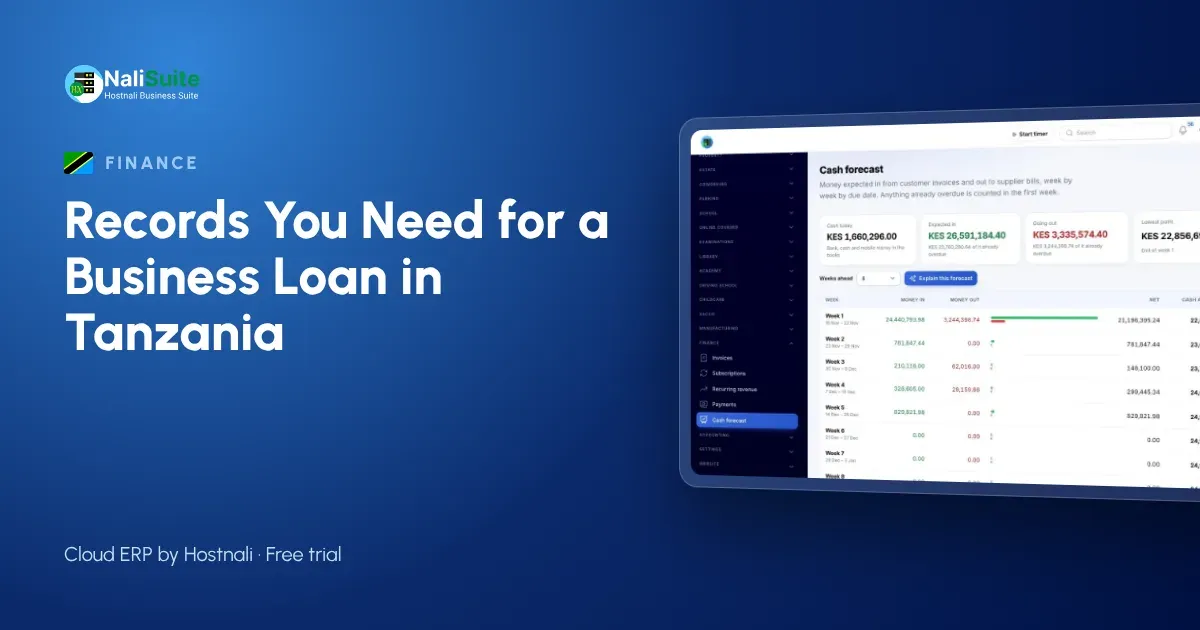
- A month-by-month cash flow forecast over the loan period, including repayments. Our cash flow tips for Tanzanian businesses show how.
- Contracts, orders or letters from customers supporting the forecast.
Mistake 7: Security documents scattered
If collateral is needed, missing or unclear ownership papers slow everything down.
Have in place: title deeds or certificates of occupancy, vehicle registration cards, equipment invoices, and guarantor details if asked. Lenders also check credit reference bureau records, so keep existing repayments on time.
An example: Joseph’s tour company in Arusha
Joseph runs a safari company with four vehicles and wants to finance a fifth before the high season. His first application stalled on three of the mistakes above: his business licence had expired, tour deposits arrived on his personal M-Pesa, and his latest accounts were over a year old.
| Fix | What Joseph did |
|---|---|
| Licence | Renewed the business licence; updated BRELA records |
| Tax | Brought returns up to date; obtained TRA tax clearance |
| Money | Business bank account for agency payments; Lipa Namba for walk-in clients |
| Accounts | Monthly accounts for the last six months |
| Debtors | List of foreign agencies with their payment history |
| Purpose | Quotation for the vehicle; forecast based on confirmed bookings |
| Security | The new vehicle and an existing vehicle’s registration card |
His second application went to a credit decision within weeks, with questions about the high-season bookings rather than about missing papers.
Keeping records lender-ready
NaliSuite Accounting records every invoice, supplier bill and payslip as it happens, so monthly profit and loss, balance sheet and cash flow statements are always current. Invoicing keeps the aged debtors list, bank and M-Pesa reconciliation shows the books agree with your statements, and Documents keeps licences, certificates and contracts in one place.
Frequently asked questions
Do lenders accept M-Pesa statements?
Many consider mobile money statements alongside bank statements. Ask the lender.
How long do I need clean records before applying?
Ask the lender. Several months of clean statements and monthly accounts make a clear difference.
Is a TRA tax clearance certificate always required?
Not always, but many lenders ask for one. Keep returns current so you can get it quickly.
Will fixing these mistakes guarantee a loan?
No. It makes your application easier and faster to assess.
Try NaliSuite
Keep your records ready for the next application. NaliSuite starts at TZS 5,500 a month with a free trial. See the plans.